- Home
- Classical Fingerstyle Portal
- 15 Actionable Guitar Lessons
- Classical Guitar Technique
- Guitar Lessons
- Beginner Lessons
- Guitar History
- The Renaissance Guitar
- Guitar Time Line
- Classical Guitar Blog
- Contact
- About Author
- Site Search
- Privacy Policy
- Site Map
- Classical Guitar Study Course 3.0
- Instant Classical Guitar Repertoire
- Classical Guitar Lessons For Beginners
Guitar History
'A Dynamic Journey of an Evocative Instrument!'
(Updated 2024)
"Guitar History - A glorious 5000 year love story..."
Although the history of guitar stretches back into 'the mists of time', there has been enough documentation of the journey over the years to give a very clear picture of just why and how it developed.
See the guitar time line here...
The main developments in guitar history came about because of the composers, players, and instrument makers of each generation impacting one another.
They were continuously evolving the
instrument right up to the present day.
They were all influenced by the times in which they lived. This was duly reflected in the different styles of playing and accompanying, and styles and taste of their craftsmanship...
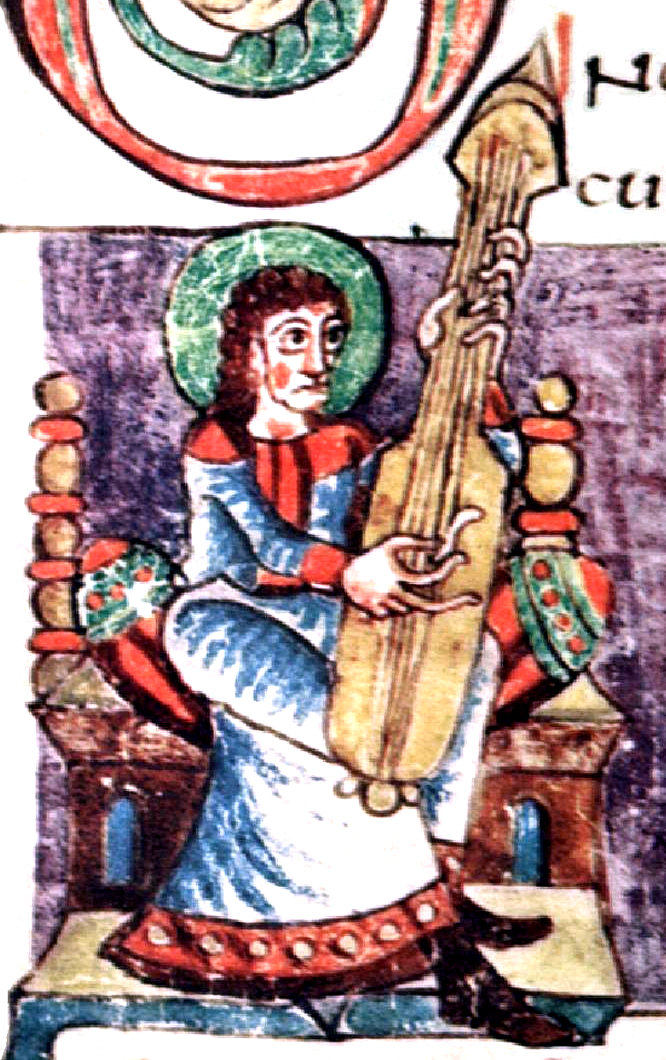 Abbey of Saint-Germain-des-Prés near Paris, France
People in the Abbey of Saint-Germain-des-Prés near Paris, France, scan fromWürttembergische Landesbibliothek Stuttgart, Germany, cleaned/colours adjusted by u3001 [Public domain]
Don't Just Get a Head Start - Get a FAST START!
One of the biggest challenges in learning to play classical guitar is to know where to start.
That's why I created the ‘Classical/Finger Style Guitar Lessons Portal’ which helps you to make a fast and logical start. You can join here...
https://www.learnclassicalguitar.com/Classical-Guitar-Fingerstyle-Portal
Oh, and did I mention - it’s FREE? 😊
Just
follow these 3 easy steps...
1. Enroll in the Classical-fingerstyle Lesson Portal here...
https://www.learnclassicalguitar.com/Classical-Guitar-Fingerstyle-Portal
2. Select the lessons you want to practice
3. Start making progress on the classical guitar
If you're really serious about learning classical guitar, you can also download your copy of...
"Ten Important Skills You Need as a Classical Guitarist" (inside the portal).
P.S. If you resonated with this idea I think you're going to love how the portal gives you an advantage and a fast start in playing classical guitar. You can join in literally seconds here...
https://www.learnclassicalguitar.com/Classical-Guitar-Fingerstyle-Portal

|
In the overall picture of guitar history and its subsequent development, the effect of the rulers and marauders of many great nations and peoples also must be considered e.g. the Moors. They caused the spread of the guitar over a wide area and over a long period of time! |
Famous Guitar Composers
|
The guitar though, was an instrument of pleasure, and as such, was there, in all of its forms, to give pleasure and gratification to all within earshot!
Indeed, its evocative and sensuous nature has always been able to seduce.
Surely, only the most emotionally cold person could resist the charms of a guitar. For centuries past, the guitar, or one of its close relatives, have been bewitching all who 'inclined their ears'...
Imagine the ancients of Egypt, Rome, and Greece on balmy nights plucking their instruments and setting the mood. Captivating, with the 'siren-like sounds' of a plucked or strummed, stringed instrument...
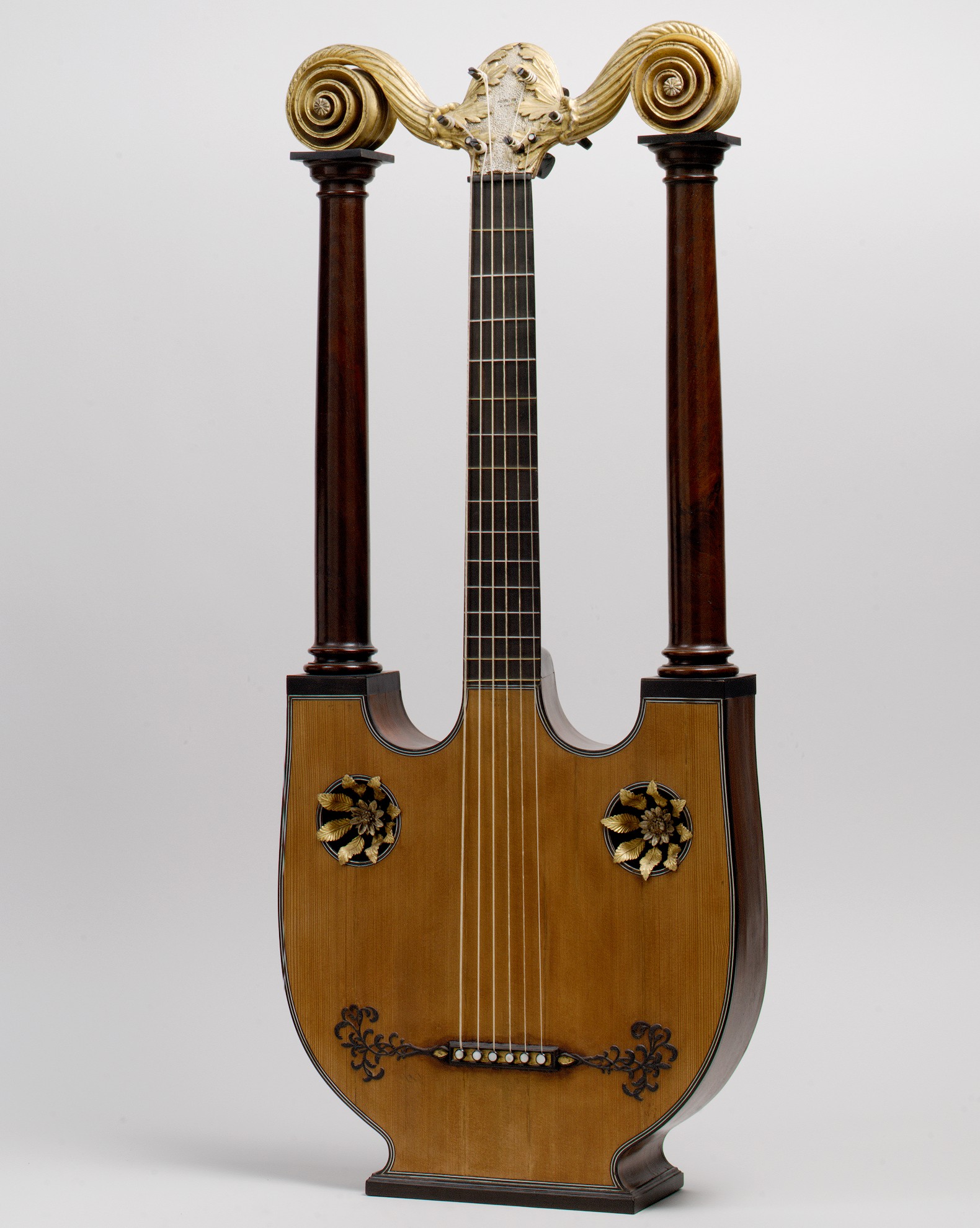 Metropolitan Museum of Art
Metropolitan Museum of Art [CC0]
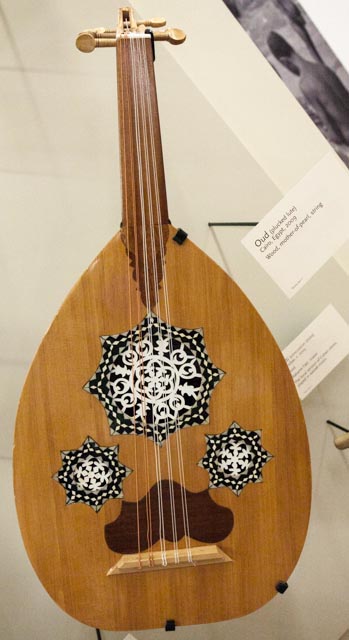 Frank Kovalchek from Anchorage, Alaska, USA Frank Kovalchek from Anchorage, Alaska, USAFrank Kovalchek from Anchorage, Alaska, USA [CC BY 2.0 (https://creativecommons.org/licenses/by/2.0)] |
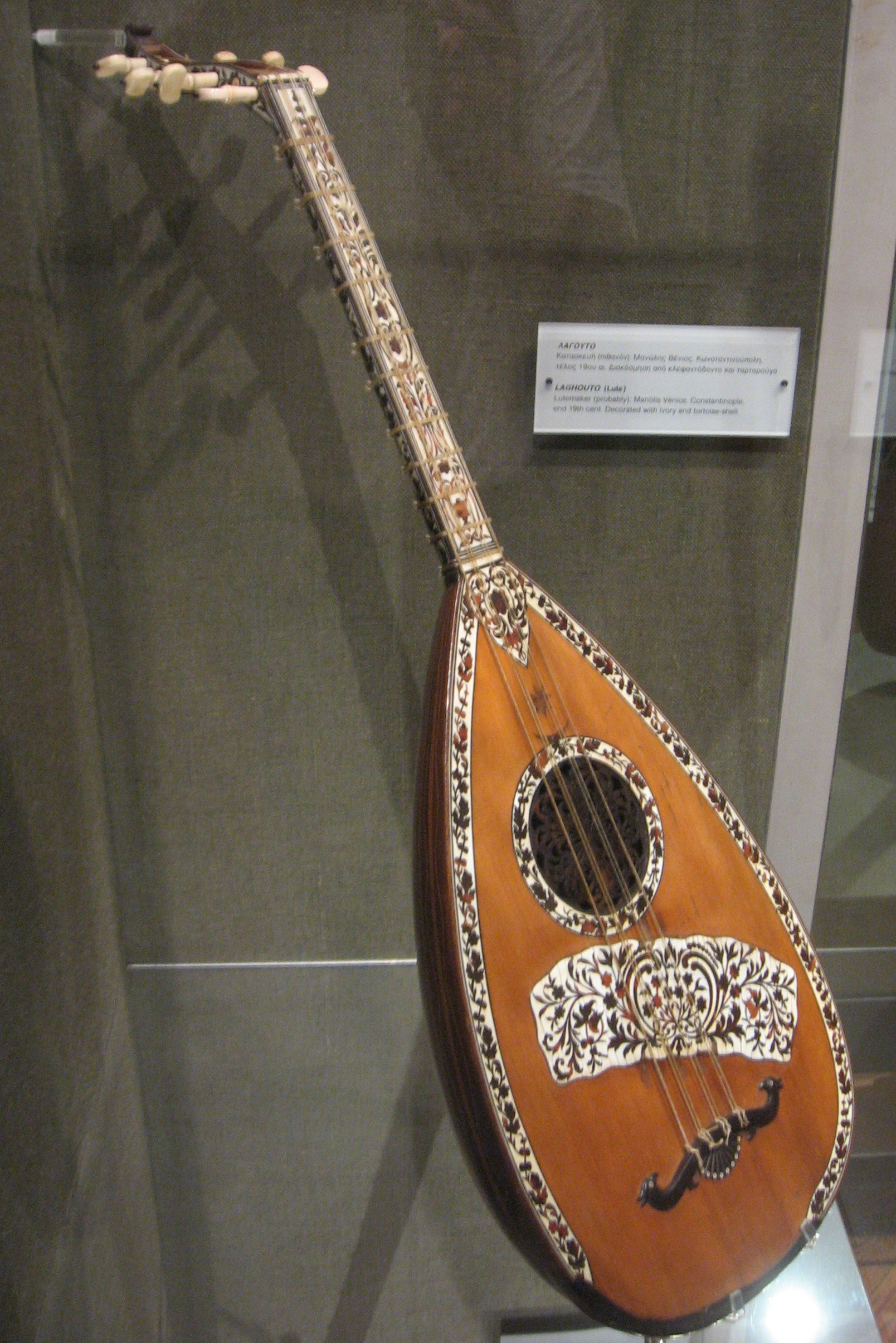 Intricate Craftsmanship Intricate CraftsmanshipPhso2 [CC BY 3.0 (https://creativecommons.org/licenses/by/3.0)] |
The men and women (mostly of the well-to-do classes!) whose only thought was of pleasure, both aural and...ahem!
(Excuse me! I got a little carried away.)
My point is, in terms of guitar history, you can't consign or restrict it to just a lifeless, emotionless, written recount of its evolution.
The guitar, indeed its history, has always been and always will be about passion, beauty and sensuousness.
Yes, there is a very intellectual side to the study of the classical guitar and guitar history but that is not (or at least shouldn't be) an end in itself.
It should be one of the 'keys to set you free'. On this point I let the eloquent and indeed romantic, Andres Segovia speak his mind and heart...
"If you look at a tree, the roots are fixed on the land, on the earth, and nevertheless the higher part of tree moves with the wind. That means it is necessary to have a great discipline and to fix this discipline, and then to move with the emotion of the moment".
Guitar History Sidebar - Did You Know?
Benjamin Franklin, the great scientist and diplomat has a place in guitar history as he was a keen player of the guitar...
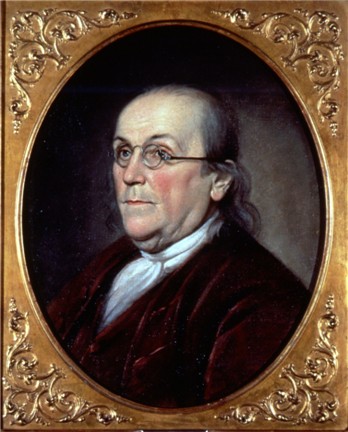 Benjamin Franklin Guitar Player
Charles Willson Peale [Public domain]
When studying history of guitar it is interesting to note that... "even kings were partial to the guitar and its distant and near cousins. It is said King Henry 8th of England whiled the time away on a 'gittern', a plucked instrument that has similarities to the modern classical guitar."
According to Maurice J. Summerfield in his excellent book on guitar history and evolution since 1800, there is some conjecture as to the guitar's origins.
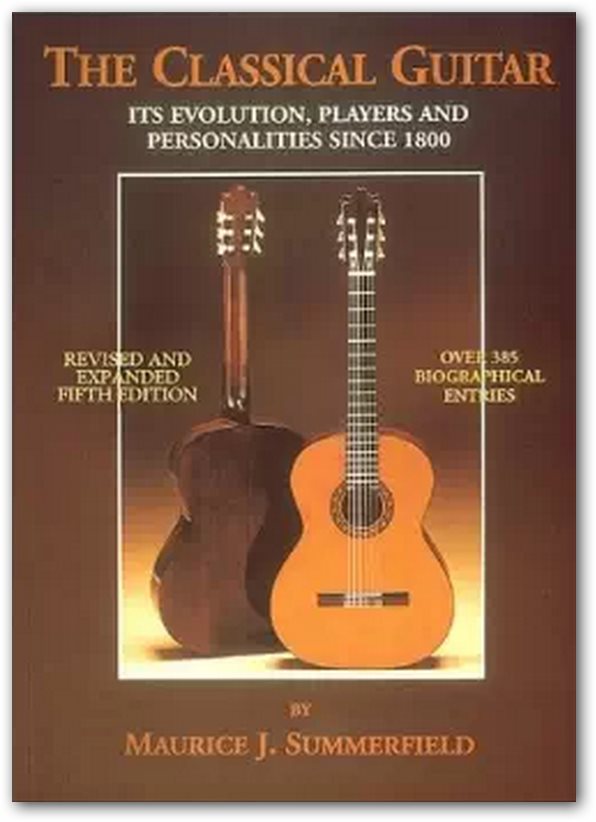
Former beliefs seemed to suggest that the guitar developed from the Persian Ud, an ancient lute-like instrument (circa 1500 B.C.).
Summerfield maintains that the Ud was the precursor of the lute, and, in fact, the Hittite Empire (roughly 1700 B.C. to 1000 B.C. in what is now Turkey) with their Tanbur was the true historical descendant of the modern day guitar.
In a timeline (using little graphics of each instrument) Summerfield details thirteen changes in guitar history and evolution from the ancient Persians and Hittites with their Tanbur's thru the Greeks, Romans and later the Moor's with the guitar morisca and the native Guitarra Latina.
Talking about "timelines", you can see the Classical Guitar Timeline here...
From there developed the vihuela and four course (another name for strings) guitar with its double strings on each 'course'.
Then logically, the five course guitar, the six course guitar until, at around 1800 saw the introduction of the six single-string guitars.
Up until this point, they were often very ornate and even delicate where the use of very thin wood and inferior (by today's standards) methods of construction were employed.
For example, the frets of these instruments were often tied on in bands that were movable so that music in different keys was possible to play.
What does this ornamentation say about the people of these times and what contribution did they make to the history of guitar?
They were totally absorbed in their craft. Totally involved in a labour of love! True passion, a meditation on beauty itself for beauty's sake. When Torres came on the scene with his excellently crafted guitars in the 1880's, the guitar took another step up on the evolutionary guitar history ladder.
They were now larger, more robust and with a 'fuller' tone.
Indeed, the strength and design of his guitars were so good that little has changed to this day in the design of the six string classical guitar.
He made guitars for many of the leading players of the time and even won a medal in an exhibition in Seville. The guitar in the twentieth century has 'exploded' into a vast array of styles and sizes according to use and requirement.
This varying of styles almost mirrors the schism of music itself last century until now you have virtually a different type of guitar for each type of music be it classical, rock, jazz etc.
True to its name though, the classical guitar had remained virtually a 'constant' in a stellar heaven of musical instruments.
A shinning example of beauty, taste and craftsmanship!
Its place in guitar history totally assured!
Guitar History Sidebar - Did You Know?
The word fret is derived from an old French word 'ferrite', meaning "banded with iron"...
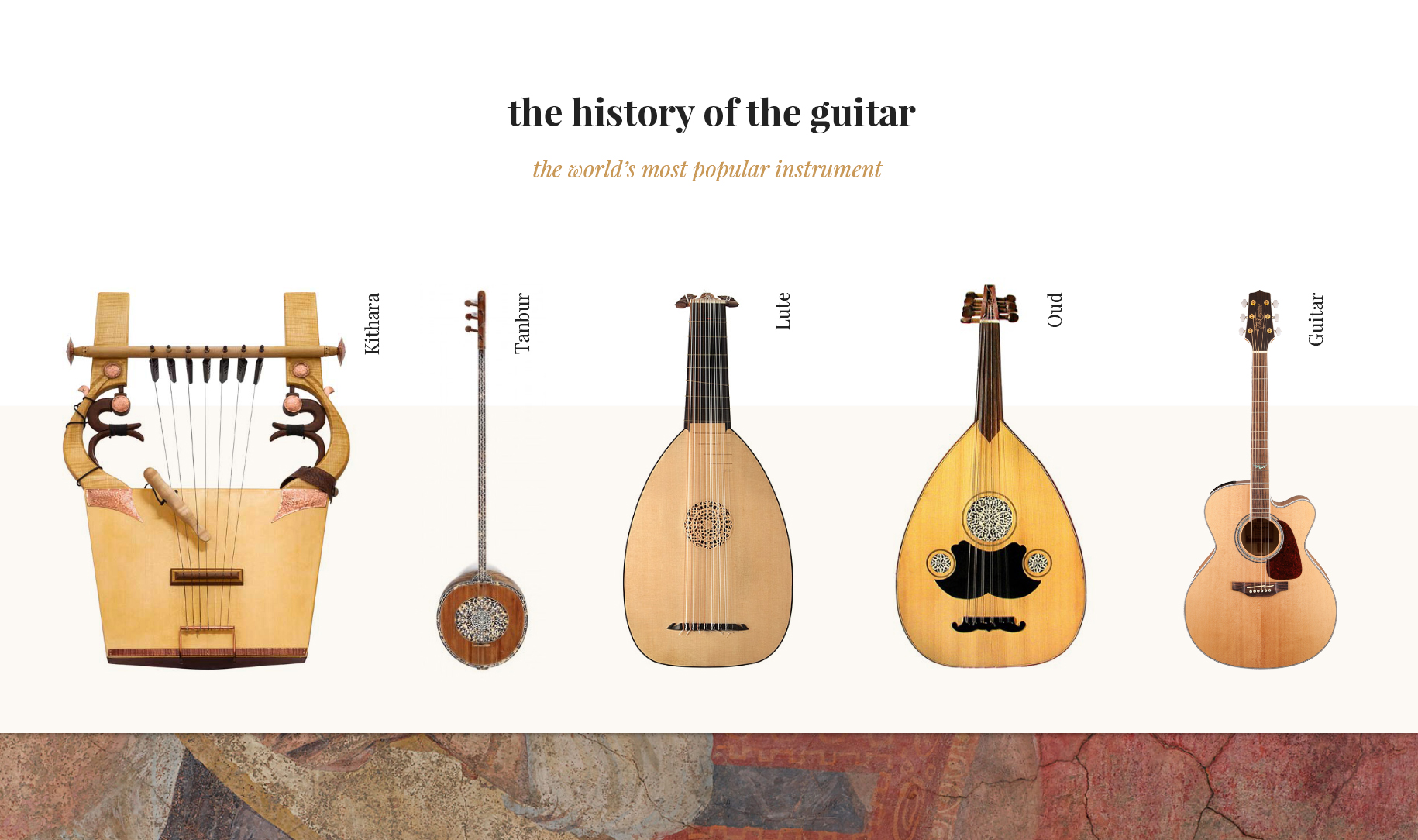 History of the Guitar
Picture courtesy of: https://www.roadietuner.com/blog/the-history-of-the-guitar-the-worlds-most-popular-instrument/
Famous Guitar Composers
Guitar History - Agustin Barrios Mangore
'Paraguayan Musical Master'
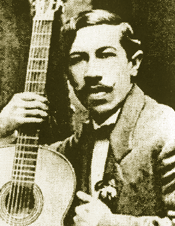 Agustin Barrios Mangore
Agustin Barrios Mangore is now the most acknowledged Paraguayan musician in guitar history.
It wasn't always so, however, and due to some famous musicians championing his music, he has come back into favoritism today.
Indeed, the world-famous classical guitar player John Williams has said of
him...
"I think he's the greatest guitar composer of all, in other words, a guitarist who wrote guitar music.
He had a real feel for form. You never thought his pieces were too long or too short, and melodically his pieces used to join up.
They were never just one little clever idea, one tune often takes you into another part of the tune almost like the great jazz guitarist Django Reinhardt"
Born in the city of San Juan in 1885, Agustin Barrios was one of eight children.
Both his parents were musical, and his mother was quite a good guitarist herself. After early study of the guitar masters: Sor, Aguado and Tarrega with his teacher, Gustavo Escalda, he was widely regarded as a child prodigy at the age of thirteen.
Mangore even excelled in other fields including poetry and calligraphy when he attended Colegio Nacional de Asuncion as one of the youngest university students in Paraguayan history.
In addition to that, he spoke multiple languages and studied mathematics and philosophy.
Moreover, he believed as was instilled in him by his family at an early age that you could not divorce the artist from culture. To be a legitimate artist, he firmly believed that you had to be immersed in modern-day culture.
Barrios it could be said behaved curiously, indeed eccentric, in later life.He took the name of a famous native chieftain and took to performing in full native dress.
In one of his poems, he described how he was chosen to be...
"Nitsuga Mangore, the 'Paganini of the guitar' by Tupa, the supreme spirit and protector of my people".
This practice was almost reminiscent of the mystical Yogis of India who 'bestow shakti' on a chosen one to continue the lineage but also engage in a special, often healing, purpose while on earth. It is obvious that his special mission was music but chiefly the guitar.
Barrios composed over three hundred works for the guitar, many of which were virtuoso-level.
He also performed all over South America and even in Europe. He was widely accepted and respected though it is said the great Segovia didn't care much for his work except for La Catedral.
That couldn't have done much for his reputation at the time seeing as Segovia was regarded as a sort of demi-god in terms of guitar history!
Luckily, history has judged him to be both a quality player but more importantly, a composer of the highest rank.
Mangore died at a relatively young man at fifty-nine years of age in El Salvador after being reduced to a shadow of his former self (due to heart disease).
To get by, he was relying on teaching, and some modest performing. That aside he is well-loved, even revered by Paraguay as one of their greatest musical heroes of guitar history.
It is well-deserved!
Check out this great little video on YouTube of David Russell playing
Julia Florida...
Guitar History - Leo Brouwer
'Master Musician'
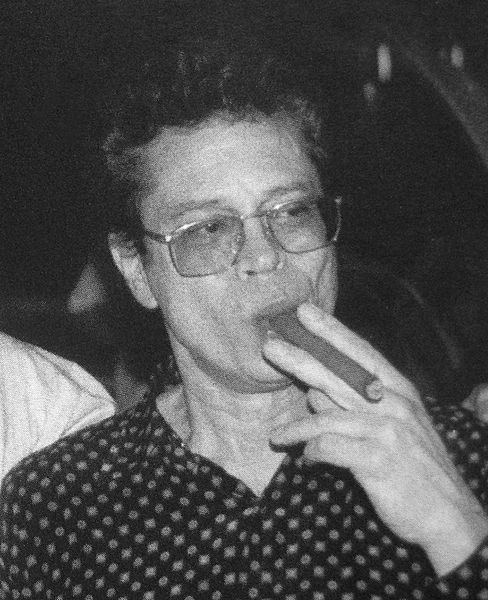 Leo Brouwer - Master Musician
Brouwer 'coolly' smoking a cigar
Leo Brouwer received his first formal guitar instruction from the noted Cuban guitar master Isaac Nicola.
He is one of the most seminal minds in the world of classical guitar and overall guitar history today. This is due not only to his God-given talent but to his wide-ranging experiences.
To view his musical 'rap-sheet' is indeed daunting for us 'mere musical mortals'. Brouwer was born in Havana, Cuba on the 1st of March 1939.
His musical prowess was impressive as he started learning the classical guitar slightly late at the age of 13. By the time he was 17 he was able to give his first public performance.
He was in good hands as his first real teacher was Isaac Nicola, who had been a pupil of the great Emilo Pujol. Later on, he attended the prestigious Julliard music school and the famous Hartt College, billed as Connecticut's Premier Performing Arts College.
Brouwer's career has spanned five decades and his achievements in both classical guitar and the general musical field are imposing indeed.
He has performed all over the world and composed music for chamber groups, ballet and film. He has also arranged the music of other composers (including The Beatles no less!) and been involved in judging in classical guitar competitions the world over.
Leo has even given workshops and master-classes, taught in conservatories and is a professor of composition.
When does the guy sleep? Oh yes, I forgot. He's also worked with some of the best orchestras in the world as a conductor.
Here's what Steven Thachuk said writing about his style of composition in the liner notes of his C.D. Brouwer: Guitar Music, Vol. 2
"As a composer, however, he is primarily self-taught, and his development as a creator of music can be traced logically through three stages of composition style.
His first period began in 1954 with a series of pieces that explored the possibilities of the guitar.
He makes free use of musical materials from his Cuban roots. Pieces with traditional forms such as fugue are present alongside works which incorporate the vital rhythmic energy of his homeland."
In 1961, he attended the Warsaw Autumn festival in Poland and met the music of avant-garde composers such as Penderecki, Baird and Bussotti. By 1968, he had assimilated these ideas into an entirely unique and personal style...
The composer has referred to his current composing style as "national Hyper-Romanticism".
His piece for guitar orchestra, Acerca del sol, el aire y la sonorisa (1978), was the first in this mature phase.
It displays all the characteristics of his new style: a return to Afro-Cuban roots mixed with elements of tonality, traditional form, programmatic gestures, and minimalism...
Approaching his seventh decade Leo Brouwer shows no signs of slowing his phenomenal influence on the world of classical guitar and guitar history in general.
Check out this great little video on YouTube.com of the composer...
Guitar History - Matteo Carcassi
'Teacher Par Excellence'
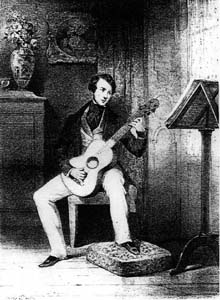 Matteo Carcassi - Teacher Par Excellence!
When Carcassi was born in 1792, Carulli was already making a name for himself as a 22-year-old, Sor was a rapidly improving 14-year-old at the Monserrat monastery and Giuliani was receiving tuition on the violin, flute and guitar as an 11-year-old.
Who was to know that in time that he would join these luminaries as one of the most famous names in classical guitar history?
Indeed, he was to become very influential in terms of technique due to his famous guitar method book (Opus 59) and his excellent studies (Opus 60).
He began to play the guitar at a very early age in his homeland of Italy. He was also receiving tuition on the piano, and it is apparent his musical education was very comprehensive and well-rounded...
By the age of twenty-three, after finding some initial fame in Germany, he went to Paris. It was here his reputation was established for all time when he both taught guitar and piano and gave many fine concerts.
Some years later he added to his already imposing reputation by playing and teaching in London. He gained further kudos as a travelling virtuoso.
He was much in demand in the salons and homes of the well-to-do classes of Europe currently.
It is said he had exceptional gifts as a player including a very solid technical mastery of the instrument, despite the fact he played without nails on the right hand.
His compositions had a decidedly French 'feel' rather than an Italian or Spanish influence, but he had a gift for simplicity much like his compatriot and friend Carulli.
He stopped performing at age 48 so that he could devote more time to composition and teaching. By the time, he died in 1853 at the age of 61 he had written almost 100 works for the guitar.
He is still a much loved and often performed composer of classical guitar works and shall remain as one of the best composers for the instrument of all time.
Guitar History Sidebar - Did You Know?
Carcassi's popularity eclipsed that of the older Carulli as the pre-eminent touring guitarist of the day....
Here's a little Carcassi piece on YouTube...
Guitar History - Fernando
Carulli
'A Man of
Musical Grace'
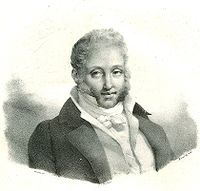 Fernando Carulli - A Man of Musical Grace!
Fernando Carulli was the author of the first complete classical guitar method in guitar history.
Born in Italy in the same year as Beethoven (1770), he became one of the most popular and loved composers and classical guitar players of his time. Indeed, that love extends right up to the present day as new generations of guitarists 'find his music' and make it their own.
This is high praise indeed because Carulli was basically a self-taught guitarist!
He was, however, a very prolific composer writing over four hundred works throughout his life. Most of these works were for solo guitar or involved the guitar in some capacity.
By the time he went to Paris, aged 38, he was a fine, cultured and highly educated musician. His music was full of charm and grace, though not highly difficult like that of his contemporaries, namely: Sor and Guiliani.
Even though, his music was often less complex than others, it did not mean less harmonic and melodic appeal.
Indeed, his real genius was writing for the amateur or dilettante. Therefore, the music publishers of the time loved him!
He was able to compose playable but quite beautiful music with ease so that the oft 'less talented', well off daughter of a nobleman or member of the upper classes could enjoy and revel in.
Guitar History Sidebar - Did You Know?
Fernando
was originally a cellist but eventually turned toward the classical guitar!
He became so popular (even famous in Paris) that he remained there for the rest of his life. It was there that he wrote his famous 'Method Book' that is still used to this day.
Additionally, many classical guitarists have become quite advanced on the instrument by mastering his concertos, studies and sonatas. I think most fair-minded players of the classical guitar would agree his fame is well deserved!
When the great man died in 1841, he had achieved quite a degree of celebrity, especially in Paris.
More than this, he left us rich vein of music that is not only aesthetically pleasing, but instructive and pleasurable, as well.
Check out this great little video on YouTube of 'Ferdinando Carulli: Guitar Concerto in E minor, 'Petit Concerto de Société', Op.140, Pepe Romero’
Guitar History - Castelnuovo-Tedesco
'Genius at 9-Years-Old'
 Mario Castelnuovo-Tedesco
It's amazing to think that Mario Castelnuovo-Tedesco composed his first pieces of music when he was just nine years old!
Born in In 1895, in Florence, Italy, Mario became one of the most famous and talented composers of the last century.
Although some of his contemporaries for his "quaint and reactionary views of music", he nevertheless went on to write not only a great quantity of music, but music of great quality.
Indeed, his output was quite prolific, writing in such forms as Concertos (including the popular guitar concertos); orchestral music; chamber music; piano music; vocal and choral music; ballets; operas; and of course, classical guitar music.
A well-rounded composer by all accounts!
It was when he met the 'ubiquitous' Segovia in 1932 that the repertoire for the guitar took a turn for the better.
Indeed, he wrote over 100 works for the guitar, some of which remain at the top of the repertoire of the concert platforms today. Who could not be moved by his guitar concertos or the Homage to Boccherini?
By the time he was twenty-three in 1918 he had studied in both Florence and Bologna. He had also graduated from the conservatories with a growing excellent reputation.
He started mixing in the highest musical circles and was very successful. In 1925, he won an award for his opera La Mandragola, which was performed for the first time in Venice.
Here's a poster for the Hollywood movie, 'Rogues of Sherwood' for which Castelnuovo-Tedesco wrote the film score...
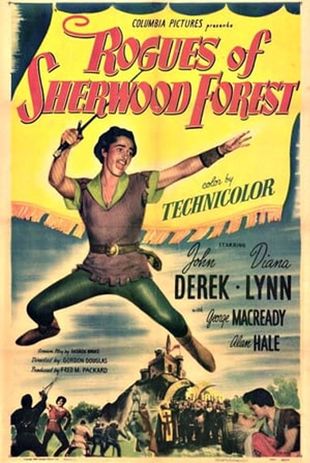 Rogues of Sherwood Forrest, music by Mario Castelnuovo-Tedesco
Picture courtesy of: https://robin-hood.fandom.com/wiki/Rogues_of_Sherwood_Forest
Castelnuovo-Tedesco continued composing, including works for the guitar, until 1939, when the "ill-wind of fascism began to blow in Italy."
Being of Spanish and Jewish heritage the family fled to America, where they could carry on their musical life in a normal fashion, without the intrusion of the idiotic and ultimately doomed fascist regime.
The weird fact was that his family had come to Italy from Spain in the 15th century because of the persecution of Jews there. So, they fled to America, the "land of dreams," where he did indeed make his mark!
It wasn't long before he landed a job with M.G.M. Studios, writing film scores and other incidental music for films. (In fact, he wrote music for over 200 films in his lifetime.)
This kept him in a sound financial position for many years. Later, he realised he was more akin to be the freelance writer, which he later became.
He continued to teach music, and he had many students who became famous. Names like John Williams (composer and conductor), Henry Mancini, Andre Previn, and Jerry Goldsmith all came under the tutelage and influence of Castelnuovo-Tedesco, whom they all admired and respected a great deal.
He died in his adopted country, California, on April 16, 1968.
No doubt many guitarists mourned the passing of this great, gentle, and generous human being the world over. He was a man who gave so much to the world of guitar, music, and overall guitar history.
Check out this great little video on YouTube of Cesar Amaro playing 'Tarantella'...
Guitar History - Napoleon
Coste
'French
Guitar Master'
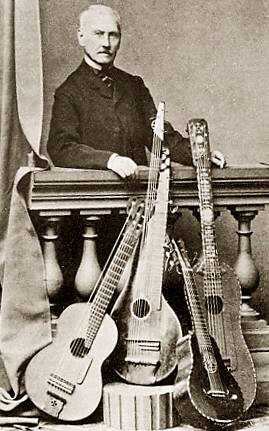 Napoleon Coste - French Guitar Master!
It is said that Napoleon Coste's mother first taught him how to play the guitar, and although he was born in the provinces; he rose to be the greatest guitarist/composer France ever produced in the guitar history.
He was also feted and lauded by Parisian aristocratic society becoming the most celebrated French guitar composer that the city had ever seen in terms of guitar history.
By the time, he was in his teens he had become both a virtuoso player and an excellent composer. Later, when he moved to Paris, he took up lessons with the great Fernando Sor himself.
Indeed, he moved in an illustrious circle of friends that included Aguado, Carulli and Carcassi.
He played for the "creme de la creme of society" and was engaged to teach them as well...quite a lucrative arrangement!
Being 'gainfully employed' allowed him to publish many of his own works later in life. Before this, he had spent ten years learning harmony and counterpoint, which greatly enhanced his powers of composition.
But later, due to an unfortunate accident, Coste was deprived of the ability to play in public again.
He broke his arm in a fall, which rendered his right hand virtually unusable. Perhaps, in an ironic way, it may have been fortunate that he fell.
Incapacitated, he was able to devote more time to composition. I'm sure deep down he must have been disappointed not to be able to play.
When you have developed yourself to such a level and then that is taken away from you cannot help but be disappointed. I suppose with his dedicated nature he got on with things and involved himself in music as much as possible.
He composed over forty works for guitar both for the six and seven string instruments.
Another achievement was to revive interest in the Baroque guitar and its music and to transcribe 17th century music to modern notation methods.
Napoleon's music is full of charm and adds greatly to the repertoire. I'm sure he compares favorably with his contemporaries and deserves to be!
Here's a wonderful Coste piece, Fantasia Dramatique, played by the excellent classical guitarist Thu Le...
Guitar History - Anton
Diabelli
'Master Musician of Note'
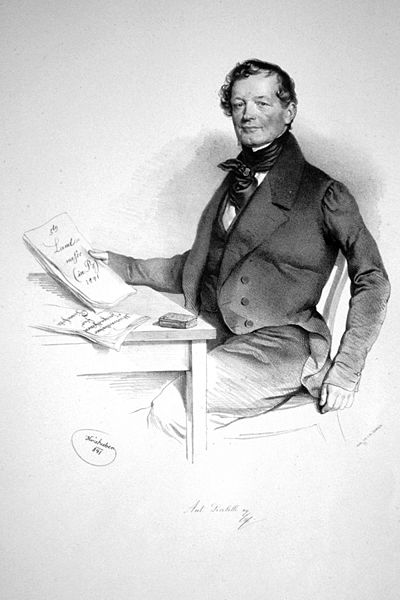 Anton Diabelli - Master Musician of Note
Diabelli is one of the more interesting guitarists and musicians of the 19th century and in all guitar history up to that point.
He played both guitar and piano and died one of the richest musicians of his time due to an interest, then ownership of a publishing house. Indeed, he was as astute a businessman as he was a musician.
If Mozart, his fellow Austrian, had been more adept he might have been as prosperous and perhaps lived as long.
Born in the small town of Mattsee near Salzburg, he almost took up the priesthood but a calling for music was too strong and won out in the end.
To this day his hometown honors his name in the summer months with a music festival called the "Diabelli Sommer", great testament to his world-renown musical skills.
He received his first musical training as a singer in monasteries and cathedrals. This stood him in good stead for his time with Michael Hayden, brother of the famous Joseph. It was the guitar that was his focus of interest.
This enabled him to link up with one of the most famous players in all guitar history, Mauro Giuliani, from whom he learned a great deal. He was able to earn a good living in Vienna around this time playing and teaching both guitar and piano.
What ‘made’ him in the monetary sense was his association with Peter Cappi in a music publishing house. He went on to buy his partner out some six years later, and so secured his future.
Relieved of the daily monetary money worries of most of his contemporaries he was able to move in "high" musical circles and have access to many of the best musicians of the day. Indeed, he was highly respected by them and published many of their works.
These musicians included no less than Beethoven, Joseph Hayden, Schubert, Czerny and Strauss!
When he retired from the publishing game in 1853 at the age of 72, and sold all his copyrights, he had over 25000 works from which to draw a pension. It was a... "hell, of a pension!"
Oh! AND a revered part in guitar history!
Although he wrote many works, including for guitar, piano, the voice and others, he is most remembered for Beethoven's 33 variations on a theme of his. Maybe it was just as well he was aligned with the "meteor" of music as his name was enshrined in musical history for evermore beyond his own renown.
Here's the lovely Barcarole by Diabelli played by Jeff Lambert...
Guitar History - Dionisio
Aguado
'Fire Like A Gypsy'
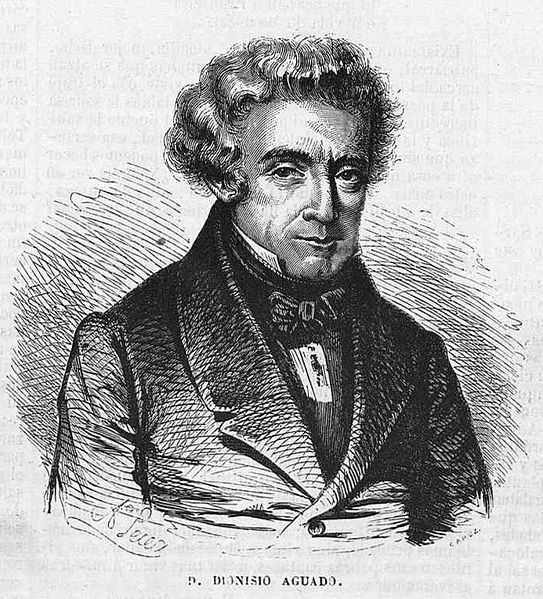 Dionisio Aguado - Fire Like A Gypsy
They probably said about Dionisio Aguado..."It's the quiet one's you have to watch out for!"
Although it was said he was shy and modest by nature, he certainly played with the fire of a Flamenco gypsy, more akin to Andalusia than his hometown of Madrid.
Born in 1784 into a religious family, Aguado showed an early aptitude for music and guitar. True to his modest nature, it took him forty years of playing the instrument to become "famous". This was when he went to live in Paris in 1824.
Aguado had inherited his father's estate some years earlier and had spent most of his time there mastering the guitar and music. This stood him in good stead for the rest of his life as he was both a master player and a very talented composer.
This is even though he is mainly remembered today in guitar history for his 'Method book'.
Guitar History Sidebar - Did You Know?
Aguado shared a house in Paris with none other than Fernando Sor. In fact, wrote a duet for himself and Aguado whilst they were living in the house together which they performed successfully at the time.
Aguado's Studies were often considered quite difficult and beyond the ability of the average guitarist.
His method book was a means of logically and systematically achieving the desired technique to master them. They contained many musical yet didactic works from beginner thru advanced.
When he played, it is said Aguado played with great speed more suited to the "earthy" sounds of flamenco. Aguado also was a proponent of using the nails on the right hand for greater clarity of tone and dynamics.
Using the skin rather than the nails one could imagine the warmth of tone he produced.
Aguado is less remembered for inventing the curious 'tripodison', a strange three-legged contraption that was supposed to support the guitar whilst playing. Aguado even claimed it increased the guitar's volume output.
This was perhaps a dubious claim, but in the end, it was academic as it fell quickly from favor in guitar history.
Overall, with an impressive output of music that is both charming and technically useful, Dionisio Aguado has added nicely to the guitarist's repertoire.
A wonderful player, a highly talented composer, and a man who reached the rarefied air of a true guitar great.
Here's the 'Introduction and Rondo No.2, Opus 2 by Aguado, played by Drew Henderson...
Guitar History - John
Dowland
'Master Lute Player and Composer'
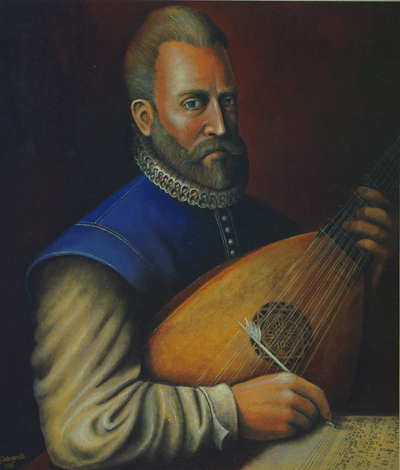 John Dowland - Master Lute Player and Composer
John Dowland was the composer of some of the most exquisitely melancholic music that has ever been written for the lute (and by default - the guitar) of all time in guitar history.
Born in London in 1563 he was one of the best lutenists of his day. A widely travelled composer he found himself in Paris in 1580, in the service of the English Ambassador of the time.
It was here that he decided to become a catholic, which, it was said, hindered his future appointment at the Protestant English court. So, seeking work abroad he travelled widely on the Continent where he even ended up at the court of Christian IV of Denmark.
He was eventually forced, by debt, to return to England in 1606 and obtained the appointment as one of the King's Lutenists in 1612.
He wrote his First Book of Songes And Ayres in 1597 which became widely popular. Three more 'collections' followed which added to his reputation as both an excellent lutenist and composer.
Indeed, he wrote more than eighty secular songs and Fantasias, Pavanes, Galliards, Almains and Jigs for the lute.
The most popular of his instrumental compositions is his famous Lachrimae or Seaven Teares.
It is said his works were both introspective and melancholy but were of great popular appeal. Being by turns both "sour and happye" in nature he was probably well positioned to reflect this through music.
This fact, it could be argued, is what gave his music its charm and appeal along with his more elaborate compositions than those of his contemporaries.
Dying in 1626 he was survived by his son, Robert, who was also a lutenist and composer of considerable skill and charm. In fact, Robert succeeded his father as lutenist to Charles the First after John's death in 1626.
Here is a 'Rare Guitar Video' of Julian Bream playing a John Dowland piece on the Lute...
Guitar History - Mauro
Giuliani
'Great Guitar Virtuoso'
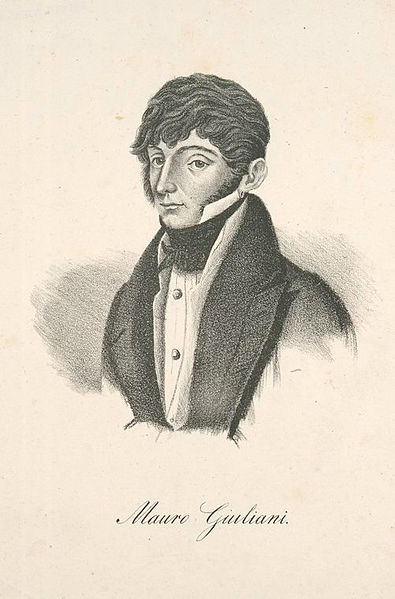 Mauro Giuliani - Great Guitar Virtuoso
Despite being self-taught on guitar, Mauro Giuliani rose to become one of the greatest guitar virtuoso's in all classical guitar history. Along the way, he gained the respect of many of the classical music giants including Beethoven and Schubert.
Born in Italy in 1780, he had made a name for himself as a virtuoso of guitar by the time he was nineteen. He was also adept at the flute and violin and by the time he died had added the title of "highly talented composer" to the list of achievements.
Indeed, he left a legacy of over 300 works for guitar and instrumental combinations, which catered for the beginner to the most advanced guitarist.
Having moved to Vienna when only 26 years of age it was here that he really made a name for himself. He gave many successful recitals to royalty and great composers alike including the Austrian royal family, Beethoven and Schubert.
His personal circle of friends included Diabelli, Mosheles, Mayseder and Hummel.
Beethoven was so impressed he stated that the guitar was... "like a mini orchestra". This was in no small way due to his music and how it highlighted the capacity of the guitar to display harmony and counterpoint.
Over the years, he toured many countries including, his native Italy, Germany and even Russia. It is also said the the German music journals were unanimous in declaring him... "the supreme of the guitar virtuosi."
In 1833, he toured London to great acclaim (it was here he met his great rival Fernando Sor who was there making a name for himself at the time) ...
Guitar History Sidebar - Did You Know?
There was a guitar magazine named after Giuliani. It carried the Moniker..."The Giulianiad".
He has remained at the top in terms of popularity in the classical guitar world up until the present day. Indeed, his future is secure, and you can be assured that the name of Mauro Giuliani shall remain in the preeminent position, in the classical guitar composer list.
Here's a quote about him that was made over 100 years ago...
"His expression and tone in guitar playing were astonishing, and a competent critic said of him: "He vocalised his adagios to a degree impossible to be imagined by those who never heard him; his melody in slow movements was no longer like the short, unavoidable staccato of the piano, requiring profusion of harmony to cover the deficient suspension of notes, but it was invested with a character, not only sustained and penetrating, but of so earnest[3] and pathetic[4] a description as to make it appear the natural characteristic of the instrument. In a word, he made the instrument sing."
—Philip James Bone, The guitar and mandolin, 1914
Here's the 'Grand Overture' Op. 61 by Giuliani played by the incomparable Ana Vidovic...
Guitar History - Luigi
Boccherini
'Fine Classical Guitar Composer'
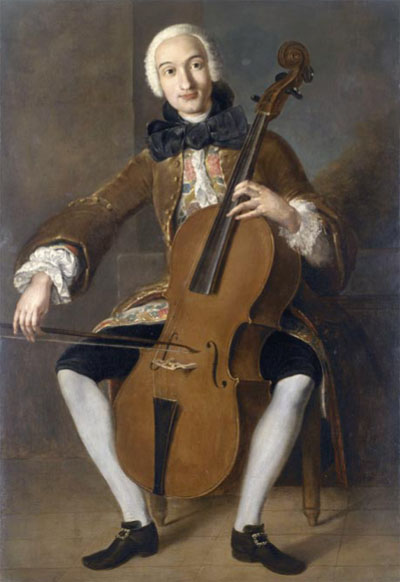 Luigi Boccherini - Fine Classical Guitar Composer
Although Luigi Boccherini was ostensibly a cellist, he made his mark on the world of classical guitar too.
Born in Lucca, Italy in the year 1743, it wasn't long before the young Boccherini soon demonstrated his prowess for music. Indeed, his composition skills were of the highest order, and it was said that he may have been the finest cellist of all time.
After developing his extraordinary talents in his formative years, Boccherini went to Vienna as a young man, before moving to Paris and then Spain.
He enjoyed the patronage of other famous characters throughout his life including Lucien Bonaparte, and even King Friedrich Wilhelm II of Prussia.
Boccherini has left us many very fine guitar quintets and quartets, but one of the most enduring pieces is the Concerto for Guitar and orchestra in E Major.
Guitar History Sidebar - Did You Know?
Luigi's Boccherini's blood line continues uninterrupted to this day.
Boccherini was known for his stylized works which were... "characterized by the typical Rococo charm, lightness, and optimism, and exhibiting melodic and rhythmic invention, coupled with frequent influences from the guitar tradition of his adopted country, Spain."
He was heavily influenced by Joseph Haydn, but some say that he exerted more an influence on Haydn than the other way around, especially in terms of the use of the cello in orchestral and chamber works.
Boccherini's output in these genres was prolific. In fact, he wrote over 100 string quintets alone but also string trios, sonatas and of course the guitar quintets.
To say he was hardworking by today's standards would be an understatement!
Boccherini remained in Spain from 1768 until his death, but his fame has spread both over time and space.
He has taken his rightful place among the upper echelon of musicians in the western tradition of guitar history, and his music has included some very fine works for the guitar - much to our gratitude!
I found a great little YouTube video of Julian Bream and... well, Julian Bream (what the...?) playing the Fandango of Luigi Boccherini...
Guitar History - Nicolo
Paganini
'Violin AND Guitar Virtuoso!'
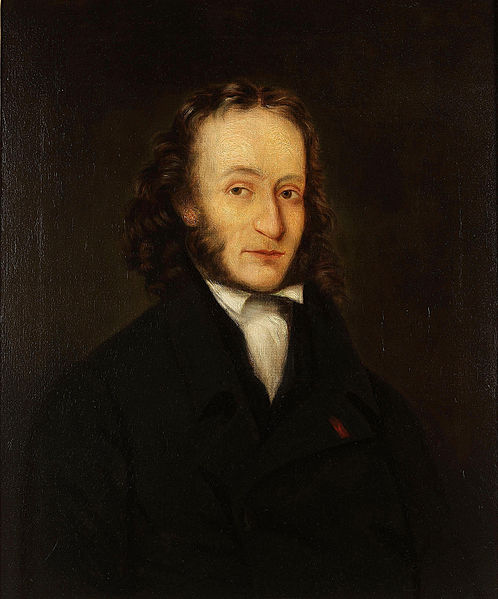 Nicolo Paganini - Violin AND Guitar Virtuoso
Nicolo Paganini is mostly remembered for being a violin virtuoso, what many people don't realize is that he was also a classical guitar virtuoso.
Born in Genoa, Italy in 1782 the young Niccolo was encouraged by his music loving father to play instruments at an early age though, not on violin OR guitar! In fact, it was the mandolin that was to be his first instrument which was taught in a rudimentary way by his father.
Paganini was made to practice for hours and hours, and it was this early practice that laid the foundation of his considerable guitar technique skills on other stringed instruments.
It was said that later he practised the violin for up to 15 hours a day!
Indeed, later in life, he was said to be "possessed by the devil" such was his alacrity on the violin being able to..."make women swoon and strong men weep."
In his early years, after his father could teach him no more, he was sent to many fine violin teachers including Giacomo Costa, Giovanni Servetto and Allessandro Rolli who probably inspired the young Nicolo to take up the guitar.
He made such rapid progress that every teacher he went to passed him on to another supposedly more experienced and knowledgeable one when he outgrew their technical and musical demands.
By the time he was nineteen, Paganini gave a highly successful concert in the town of Lucca (the city of one hundred churches), in the Tuscany region. Soon after, he became the concertmaster of the National Orchestra there.
Although highly successful, he didn't always have the strength of character to evade common social ills, namely: alcohol and gambling.
Luckily, he was 'saved' by a mysterious and, to this day, unknown aristocratic mistress who looked after him for three years.
It was said she was mainly a lover of guitar rather than the violin and due to her charms Paganini concentrated almost exclusively on the instrument in this period.
Indeed, it is thought that he composed six violin and guitar sonatas, quartets for violin, viola, cello and guitar and other guitar works whilst staying with his mysterious lover.
He strangely refused to allow most of his compositions to be printed in his lifetime. An often-forgotten fact was that he was made a 'Knight of the Golden Spur' by Pope Leo XII.
The Golden Spur was usually conferred on nobility, but also can be given to distinguish those who have served the Church or society.
By 1805, he returned to the rather lucrative profession of touring the countryside. As usual he was feted everywhere he went, and his coffers bulged once again. When Princess Elisa Baciocchi (the sister of Napoleon) became ruler of Lucca in 1805, he returned there and became firstly a 2nd violinist in the court orchestra and then solo court violinist in 1807. He retained several other courts positions up until 1809 when he tired of that somewhat restrictive life.
Paganini again turned to touring as a virtuoso and became wildly famous throughout all Italy and subsequently throughout Europe including Vienna, Berlin and even reaching Great Britain.
His health had not been good throughout most of his life, and by his early fifties it was starting to wane seriously. He gave his last public concert in Turin in 1837.
Within three years, he would be dead at the age of just 57. Having composed numerous solos, duets, trios and quartets for guitar and other instruments he must be considered as both one of its finest composers and players in the story that is, guitar history!
Check out this great video on YouTube of Li Jie playing the Caprice No.24. She's an adult now, but this was recorded when she was about 13 or 14.
It's phenomenal playing!!!
Guitar History - Manuel
Ponce
'Mexican Musical Master'
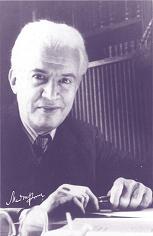 Manuel Ponce - Mexican Musical Master
Manuel Ponce was born in 1882 and died in 1948 and started composing at about the age of seven after he received early musical training from a sister.
Who knew he would become inextricably linked with both Segovia and guitar history?
By the time he was 22, he was studying piano and composition in Italy and Germany. He moved to Paris in the 1920's and studied with the French composer Paul Dukas. So impressed was Dukas by his music he once gave him a 30 out of 10 rating in an exam!
He developed a very nationalistic style based on his Mexican origins. His style was heavily influenced by European music. It was also infused with his native folk music, to create a truly individual sound.
Indeed, he collected and arranged many folk tunes which helped to define a true 'Mexican voice' in music of the day.
The great Villa-Lobos once said of this great composer...
"It gave me great joy to learn that, in that distant part of my continent, there was another artist who was arming himself with the resources of the folklore of his people in the struggle for the future musical independence of his country."
He wrote most of his guitar works with Segovia in mind. They were close friends and collaborated on many occasions over their professional careers. He had to live in Havana, Cuba from 1915 to 1917 because of the political upheaval of the Mexican revolution.
This turned out to be fortuitous as he was able to imbibe the local music, with its sultry rhythms and lively dance forms, which became a feature of his music.
Not limited to be a composer, he once was the editor of the Musical Gazette, which championed the music of the Latin peoples.
He later published and edited another magazine called 'Cultura Musical' whist in Mexico. He was a composer of the finest rank, and he almost single-handedly, put Mexico on the world musical map.
Check out this great little video on YouTube of Andres Segovia playing the Balletto by "our man Manuel"...
Guitar History - Joaquin
Rodrigo
'Folkloric Traditions'
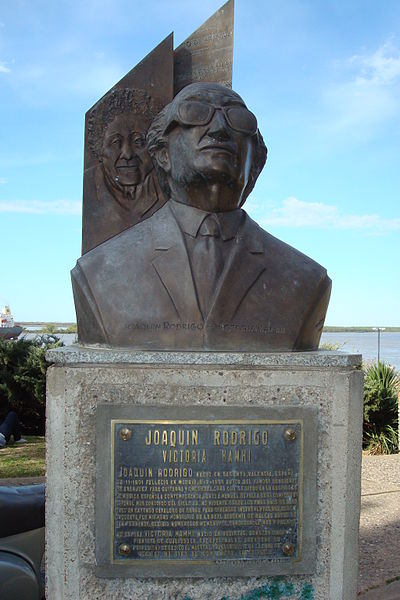 Joaquin Rodrigo - Folkloric Traditions
Joaquin Rodrigo was perhaps one of the greatest composers of the 20th century.
Borrowing heavily from the Spanish folkloric traditions, his music was rich and sensual and honest in the sense that it stayed true to its origins. Born in 1901 in Valencia, Spain, Rodrigo was blinded at an early age due to a diphtheria epidemic.
He always maintained that this was perhaps a stroke of "luck" as it allowed him to be totally involved in music in a way he may not have been if he didn't become sight-impaired.
Thus, his position in guitar history was ensured.
He was well versed in classical literature and music and from an early age demonstrated that music was indeed his destiny.
He studied as a young man with Paul Dukas in Paris for five years. Paris, being an important cultural center at the time for musicians, writers and painters, was the perfect place for his eager mind and talents.
It was in Paris while studying with Dukas that he met and befriended Manuel de Falla.
This friendship lasted right up until Falla's death in 1946. Falla was always a supporter, championing his music at any opportunity.
In fact, when Falla was admitted as a member of the French Legion d'Honneur, he insisted that his music be played on the same ceremonial concert program with his own.
A great honour indeed!
At around the same time, he met Manuel de Falla he married the Turkish pianist Victoria Kamhi. It was a very successful union lasting over 60 years until her death in 1997.
She was by all accounts, a very talented musician. She also spoke several languages, which was great for the blind man when he travelled, around the world, to take up his many musical posts throughout his life.
Guitar History Sidebar - Did You Know?
Rodrigo had a secretary, Rafael Ibanez, who read all the important classical literature, philosophy and essays of time to him due to his blindness.
A defining moment for the classical guitar history came when he met the talented guitarist Regino Sainz de la Maza in 1938.
Out of this seminal meeting of great musical minds was born the sublime Concerto De Aranjuez (composed in 1939). Indeed, Sainz de la Maza first performed this very important guitar work in 1940 in Barcelona.
Perhaps it has become the most famous guitar piece ever written and is always popular with the public and classical guitarists alike.
Because of the success of the Aranjuez concerto he was persuaded to write guitar pieces for other famous guitarists of the day. Namely: Segovia and later, Pepe Romero.
Kay Jaffe, the noted musician and musicologist wrote...
"Although not himself a guitarist, he wrote with amazing sensitivity to the instrument's particular characteristics and demands...his Concerto de Aranjuez and his Fantasia Para un Gentilhombre for guitar and orchestra, are among the most important and popular contributions to the guitar repertory..."
Although he wrote mainly in the classical idiom, he was heavily influenced by the Spanish folk traditions.
These folk melodies always filtered through into his music. One critic noted on the debut of the Aranjuez concerto that...
"It is impossible to find another Spanish work with such exciting picturesque qualities and formal perfection. For the first time in the history of our music the picturesque and the classical are fused, reciprocally mitigating and enlivening each other."
By the time he died in 1999, for his services to music, he had received over 20 awards, medals and honorary doctorates. Although not a guitarist, he made the classical guitar shine in a way it hadn't previously done.
He gave it more credibility as a true classical instrument, capable of complex, yet beautiful harmony and melodies that reflect the entire range of musical feeling and emotion.
Yes, Rodrigo's place in the annals of the greatest classical guitar composers of all time AND classical guitar history overall is forever secured!
Check out this great little video on YouTube of Cameron O'Connor playing Fandango by Rodrigo...
Guitar History - Gaspar Sanz
'Pre-Eminent Baroque Guitarist of His Time'
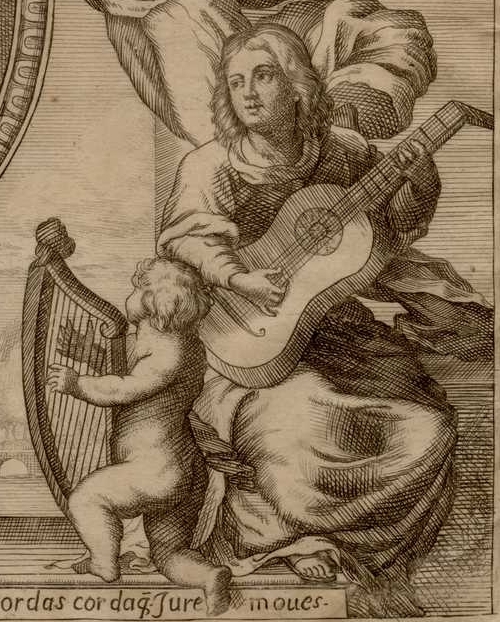 Gaspar Sanz - Pre-Eminent Baroque Guitarist of His Time
Gaspar Sanz was a Spanish composer and guitarist born in 1640 and dying circa 1710.
He became a professor of music graduating from Salamanca University, the second oldest university in Spain. He is highly regarded in guitar history and received early musical training from a sister.
Who knew he would become inextricably linked with both Segovia and guitar history?
Sanz was also a dedicated priest who took holy orders and his music cannot be separated from his lifelong strong faith. Indeed, it added a wonderfully rich and spiritual dimension to his music.
He furthered his music education in Rome under Orazio Benevoli and other musical figures such as Cristofaro Caresana and Lelio Colista.
Sanz was a superb musician, playing both organ and guitar and eventually published a guitar treatise (containing three volumes) and pieces for instructional purposes.
Indeed, he was considered the master of baroque guitar in his time and wrote some wonderful music including Canarios, Pavanas and Espanoleta which are still popular on the guitar today.
He also wrote many of Spanish folk songs and dances.
Such guitar luminaries as John Williams have recorded the Canarios on several occasions.
The Canarios is fascinating to us mainly due to its irregular rhythms which are like much flamenco music of today.
It is a mixed meter of 3/4 and 6/8 time. He also wrote music of power and majesty. For example, the Pavanas, which is to be played Maestoso, and is full of deep emotion.
A recent editorial review of his work said...
"Gaspar was one of the most celebrated guitarists and composers of his time. In 1674, he published a method for the baroque guitar.
This method has been lauded by guitar aficionados and serves as a significant historic work. Written in Old Spanish with the tablature system of its day, this method has only been available to the few who would meticulously research and decipher its hidden meanings."
As you can see, he was a true 'man of his time'. I often wonder what people like Gaspar would think of our modern world with its hustle and bustle AND with our penchant for computers and technology.
He may even think that music software notation was the work of the devil!
E gads!!! :)
Here's
a little YouTube video of John Williams playing the Canarios...
Guitar History - Fernando
Sor
'Classical, Yet Romantic Master'
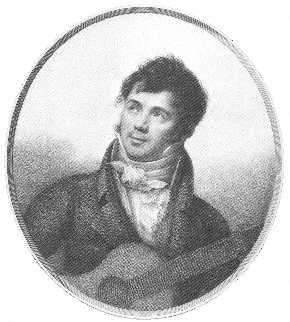 Fernando Sor - Classical, Yet Romantic Master
Fernando Sor was in no small way responsible for the resurgence of the guitar in the 18th century, helping it to eclipse the harp as the pre-eminent salon instrument of the day.
Born in Barcelona in 1778, Fernando was a classical composer, though he was heavily "colored" by Romanticism. He was by all accounts, a talented composer who wrote operas, ballets, symphonies, string quartets, songs for voice and guitar accompaniment and more.
He is probably the most famous classical guitar composer on the guitar time line.
Indeed, his first work was an opera performed when he was only nineteen. He is best known for his method of guitar and theory of harmony, adapted for guitar.
Fernando even studied violin, cello and piano and was taught composition by Anselmo Viola, who was a major 18th century composer in the Monserrat monastery where he first attended Choir School.
Later, he attended military school and was said to be quite a capable soldier, rising to the rank of captain.
He kept composing throughout his military enlistment (even composing patriotic songs to motivate his comrades against the French Napoleonic army, who had invaded them).
When the French defeated the Spaniards, he was influenced by their ideals of liberty and egalitarianism. He even worked for them in a clerical capacity for some time. This caused the ire of his countrymen.
Indeed, he was considered a traitor by some and found it necessary to withdraw to France with Napoleon's army when they were finally defeated in 1813.
He led a somewhat nomadic life after this point but never returned to his homeland.
As well as France he went to England, Prussia and even Russia. Beethoven is supposed to have stolen the theme for the 'Moonlight Sonata' from Sors. Also, whilst in Russia, he wrote the funeral march for Alexander the 1st.
Whilst he was in London, he started writing his more serious works for guitar.
Fernando also continued to play guitar, and when he returned to Paris in 1826 he was regarded as the "best guitarist in the world." We know now that he was perhaps the greatest composer for classical guitar of all time.
This is even though when he died in 1839 (of cancer of the tongue) he was all but forgotten and near penniless.
A fate unfitting such a fine composer and the player who has enriched the repertoire of the guitar greatly. One of the finest in guitar history!
Check out this great little video on YouTube of Julian Bream playing Study in B minor...
Guitar History - Alexandre
Tansman
'Prolific composer and virtuoso
pianist'
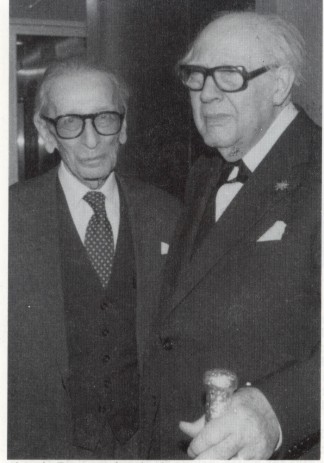 Alexandre Tansman - Prolific composer and virtuoso pianist
Alexandre Tansman was born in Lodz, Poland, on the 11th of June 1897 (the year of Johannes Brahms death) and died in Paris, France, on November 15, 1986.
Although Tansman came from a Jewish family, it has been said elsewhere that...
"The degree and level of his family's involvement with Judaism and Jewish life has yet to be established".
He did, however, leave France where he'd settled and spent time in America when the dark pall of Hitler's Reich descended upon Europe.
His place in guitar history is well deserved.
He was a pianist (a virtuoso at that) who also wrote brilliantly for the guitar. He initially trained at the Lodz conservatory and was by turns a pianist, composer and conductor of great merit. Indeed, he was a pianist with the Boston Symphony Orchestra no less!
He met the ubiquitous Segovia in Paris in 1921 where Segovia convinced him of the enduring charm and beauty of the guitar, subsequently convincing him to write many great pieces for it.
Tansman's guitar works are:
- Cavatina (A work in 4 parts);
- Danza Pomposa; Mazurka;
- Suite in Modo Polonico;
- Variations Sur un theme de Scriabin;
- Homage a Chopin;
- Pezzo in modo antivo;
- Hommage a Lech Walesa;
- Deux Chansons Populaires.
His scope of work includes opera, ballets, other solo instrumental work, chamber music, choral music and orchestral works.
His Cavatina, mentioned above, even won the prestigious International Music Competition in Sienna, Italy in 1952.
Although he spent a great deal of his life in France and abroad, he remained internally loyal to his Polish roots.
Segovia met Tansman in 1921. He wrote probably the second most famous Cavatina in guitar history! Of course, the most famous one being Cavatina that was the theme music to The Deer Hunter movie and was written by Stanley Myers.
He moved among the musical elite and the "who's who of musicians" of his time and although had many outside musical influences, always retained a strong national 'flavor' to his music, which was lyrical and seemed to incorporate a neo-classical style.
Surely, he must be rated with Chopin as Poland's most cherished musical "treasures" of all time.
Here's
his Barcarole played on YouTube by Edson Lopes...
Guitar History - Francisco
Tarrega
'Father of Classical Guitar'
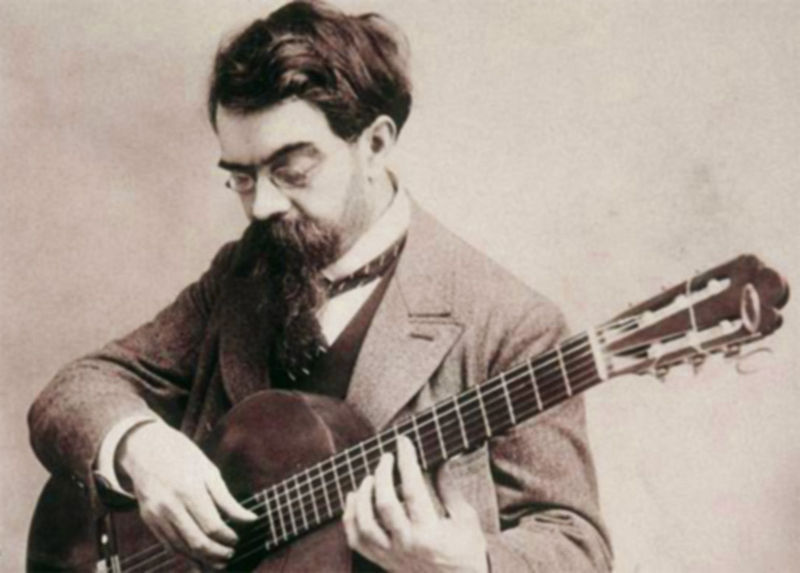 Francisco Tarrega - The 'Father of Classical Guitar'
Francisco Tarrega was one of the most influential composers and guitarists, often considered the "father of modern classical guitar..."
Although he played both piano and guitar, it was the guitar that really captured the young Francisco's heart and mind and to which he dedicated himself.
Lucky for us as he is one of the most loved and played musicians in all of guitar history.
It has been reported that he became uneasy if not in proximity to a guitar, such was his love and attachment to the instrument.
Born in Spain in 1852, Tarrega took up guitar lessons at a very early age with a teacher in his town called Manuel Gonzalez.
By the end of his life in 1909, he had perhaps become the most influential and popular classical guitarist, along with Segovia, ever known in guitar history. Making giant strides on the instrument, it wasn't long before the young Tarrega was performing concerts in his hometown of Villareal.
By the age of 22, he was ensconced in the Madrid Conservatory where he studied both piano and guitar and excelled in both harmony and composition.
After his time at the conservatory he made a career from teaching and giving recitals.
Although pre-disposed to the 'small' setting of a salon rather than the larger concert hall, he played to very appreciative audiences and was much revered both in his native Spain and abroad.
Some say it was the use of flesh rather than nails, with the resultant lower volume that prevented him from playing in the larger concert halls. Others believe that it was the fact he suffered from ophthalmia which made it difficult for him to perform at his best.
Guitar History Sidebar - Did You Know?
He
was almost drowned by his lunatic nursemaid in a poisoned stream when he was a
little boy. It is said this act brought on his ophthalmia from which he
suffered for the rest of his life.
Having achieved virtuosity on the guitar, Tarrega looked for more challenges when still a young man.
He toured throughout Europe to rapturous acclaim. He also gained the professorship of guitar at both the Madrid and Barcelona universities where he exerted his influence and considerable knowledge for many years.
Indeed, some of his pupils have become very famous names in the world of classical guitar. These names include Pujol, Fortea, and Llobet.
Tarrega was also responsible for improving the technique and posture on guitar.
He also vastly updated and improved the repertoire for guitar. Arranging both guitar pieces, and other classical tunes (that weren't written for the guitar) made them seem as though they had indeed been written for one.
They included tunes from such musical luminaries as Bach, Beethoven, Schubert, Haydn and Schumann. Who could forget the luscious tunes of Albeniz and Granados?
It is said that when Albeniz heard Francisco's transcriptions of his tunes he thought that they belonged more to the guitar than the piano for which they were originally written.
His own original tunes have become a staple of classical guitar and have stood the test of time over many decades. They have been described as "beautiful miniatures” and are excellent examples of perfect form in music.
Such tunes as Recuerdos de la Alhambra, Caprichio Arabe, Variaciones Sobre el Carnaval de Valencia and his beautiful Preludes, embody such timeless musical beauty, powerful in their emotional 'pull' and dynamic in their musical energy.
Without Francisco Tarrega, the classical guitar would be that much less appealing. With his music and tireless pedagogy, we have a repertoire that is both credible and has enormous popular appeal.
This has allowed the guitar to flourish as one of the most popular instruments of all time.
Check out this great little video on YouTube of Carlos Barbosa Lima playing Tarrega's La Alborada...
Guitar History - Heitor
Villa-Lobos
'El
Presidente Of Brazilian Classical Guitar Music'
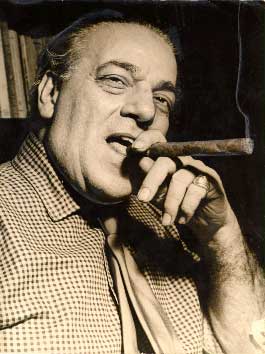 Heitor Villa-Lobos - El Presidente Of Brazilian Classical Guitar Music
Heitor Villa-Lobos was a Brazilian composer whose works, including symphonies, operas, and songs, were influenced by Brazilian folk traditions.
Born in 1887 then dying at the age of 72 in 1959, he was both a popular and important composer.
Indeed, in the 'musical firmament' and general guitar history he holds a pre-eminent position. Villa-Lobos was the first South American composer to become internationally famous whose fame and popularity have continued unabated to the present day.
When young, Heitor earned his living as an orchestral player.
He was a multi-instrumentalist being able to play cello, guitar, clarinet and piano. Although he was not a virtuoso guitarist, he was quite a good one who understood the peculiar technical complexities of the guitar.
In the early part of the twentieth century, he toured the country to find examples of folk music and for 5 years imbibed the flavor, texture and soul of Brazilian music.
It was no wonder that it influenced his compositions thereafter.
In 1922, he received a fellowship from the Brazilian government to visit Paris and remained there until 1926. It was there he met Segovia which resulted in a lifelong friendship and was important from the point of view of extending and improving the repertoire of guitar.
Indeed, Segovia once said...
"He has given to the history of guitar fruits of his talent as luxuriant and savory as those of Scarlatti and Chopin."
Villa-Lobos' output of music was prolific at approximately two thousand works.
The music is an eclectic mix of Brazilian Indian and folk music and European impressionism, especially that of Debussy. Writing in this most individual style easily made him the most important figure in Brazilian musical life in the first half of the twentieth century.
To think that he was essentially self-taught made his prominent rise more remarkable.
Indeed, he was good enough to be made the director of the national musical academy at the relatively young age of 43.
By the age of 45, was he in charge of the country's musical education! Villa-Lobos founded the Conservatorio Nacional de Canto Orfeonic for music teachers, which would provide musical life and sustenance in Brazilian schools.
He excelled in writing the "Choros", which consists of variations of wind and string instruments and even choral elements.
Orchestration can be widely varied from a single guitar to the whole orchestra. He was no one-trick pony writing symphonies, symphonic poems, a cello concerto, choros, chamber music, choral works, piano solos and songs.
My personal favorite, after the 5 preludes, is 'The Little Train of the Caipira.'
Having taught in music in many primary (elementary) schools I can attest to its popularity, especially among the younger students. They respond to the rhythmic and musical charm of Villa-Lobos' easy style.
No wonder he has remained in such an exalted position in guitar history for all these years!
Check
out this video RARE video of Villa-Lobos on YouTube playing his own Prelude No.2 ...
Famous Classical Guitar Players
Guitar History - David Russell
'Inspired Artistry'
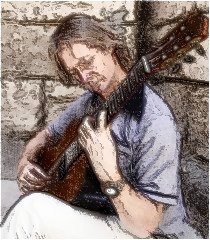 David Russell - Inspired Artistry
David Russell is world renowned for his superb musicianship and inspired artistry.
A Vancouver Sun reviewer said of Russell...
"His command of the guitar is imposing...superb guitar technique at the service of a musical mind..." he must have known that he was now accepted in the upper echelons of the guitar world.
Born in Scotland, but living in Menorca for most of his young life, Russell began playing the guitar when he was quite small. By the time, he was sixteen he moved to London to further his guitar study with the renowned Hector Quine.
Russell's talent must have been immense because whilst at the Royal College of Music in London he twice won the prestigious Julian Bream medal.
He even obtained the Vaughn Williams Foundation Scholarship. Also, whilst studying in Spain with Jose Thomas, he won the Ramirez competition.
He even won a Tarrega and a Segovia competition some years later such was his imposing ability.
It must have been gratifying for Russell when in 1976, he was named the "Young Musician of London" by the London Arts Association.
Russell is so highly regarded that many composers have written works for him including Morel and Santorsola. Although living for the most part in Spain, Russell has continued to travel, around the world, to perform including Canada and the United States.
Indeed, when he played in New York the reviewer wrote of his performance...
"Mr Russell made his mastery evident without ever deviating from an approach that placed musical values above mere display. It was very apparent to the audience throughout the recital that Mr Russell possesses a talent of extraordinary dimension."
Guitar History Sidebar - Did You Know?
His father was also a very accomplished guitarist and was his son's first teacher on the instrument.
Russell has added significantly to the world of classical guitar and guitar history with his mastery and obvious love for the instrument, which shines through whenever he graces us with a performance, be it live or recorded.
A stellar talent!
Check out this great little video on YouTube of Mr Russell playing playing "Sons de Carrilhoes" by Joao Pernambuco...
Guitar History - Alirio Diaz
'Master
Classical Guitar Player'
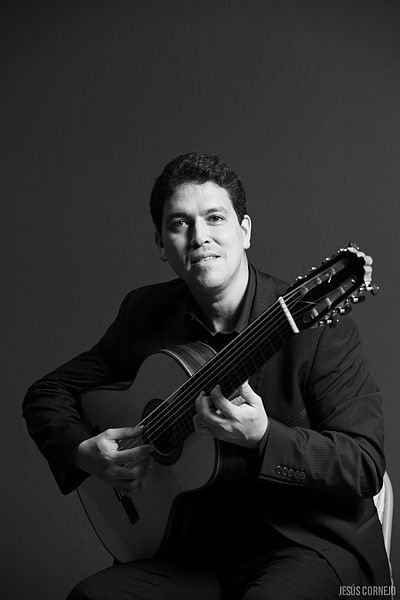 Alirio Diaz - Master Classical Guitar Player
It was said that Alirio Diaz impressed Segovia with his flawless technique and extensive repertoire.
He was born in Venezuela in 1923 into a large family of eleven brothers. He took an early interest in guitar and showed great promise on the instrument, although he was attracted to other instruments as well, such as the saxophone and clarinet.
His first teacher was his uncle who taught him to play by ear, but it became apparent that to go further with the guitar he would have to have a more formal education in guitar technique.
At fifteen, Alirio started studying theory. He became so adept at his studies that he managed to earn a living as a proof-reader.
When he was twenty-two years old, he went to the Venezuelan capital of Caracas to study the guitar further under the tutelage of Raul Borges at the Conservatory.
He made good progress over the ensuing five years, and it was after this that he was awarded a scholarship to study the guitar in Spain with none-other than Regino Sainz de la Maza.
This time proved seminal for him as he began giving highly successful concerts. In 1951, he went to see Segovia in Italy where the master was giving his summer schools at Siena in the romantic and beautiful Tuscany region.
Segovia was so impressed with his ability, musicianship and professionalism that he eventually hired him as an assistant.
Alirio has toured many countries including all over Europe and both North and South America, Japan and Australia.
Guitar History Sidebar - Did You Know?
He
studied English and typewriting before going to Caracas in 1945 to study the
guitar at the Escuela Superior de Musica Jose Angel Lamas under Raul Borges.
Although he is not always regarded as one of the most popular world guitarists, he should be.
His musicianship, excellent technical skills and focus over many, many years should ensure that he remains one of the instrument's finer players.
Watch a little Google video of him playing the Fandanguillo by Turina...
Guitar History - Celedonio
Romero
Classical Guitar 'Daddy of Them All'
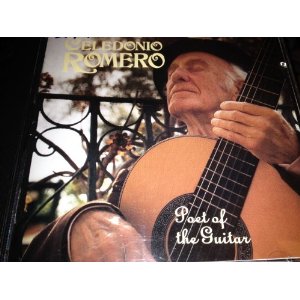 Celedonio Romero - Classical Guitar 'Daddy of Them All'
Celedonio Romero was guitarist, composer and poet, but perhaps best known as the founder of the 'Romeros Guitar Quartet', which included his now-famous sons of course.
Romero was a very brave man indeed, more so than your average classical guitar player throughout guitar history.
Not only did he have the courage of his convictions in publicly opposing a despised dictator in General Franco, he also decided to leave his beloved country of birth and make a new life for his family in America with little more than loose change in his pocket.
How many of us today could say we live or lived with such commitment and conviction?
The strong character of Celedonio is immediately apparent in all his off-spring including his sons Celin, Pepe, Angel and their children who are included in the current incarnation of the Los Romeros Quartet. Indeed, they are widely regarded as the 'Royal family of Classical Guitar'...
No other guitar family in guitar history could be more deserving of such a title so much have they done to advance the cause of classical guitar and so deep and rich is their talent on the instrument.
It all began with the young Celedonio Romero displaying an early gift for the instrument.
Born in 1913, by the time he was 10 he had already given his first concert on the classical guitar and his studies continued until the age of 20 where he was able to give his first formal concert.
Unfortunately, at that time Romero's leftist leanings were starting to make him unpopular. Indeed, some years later the Fascist Franco regime did restrict him heavily in his movements throughout Spain and the rest of Europe.
Because of these 'distractions" he settled in Southern California (which reminded him of his native Madrid) and set to work to establish his reputation and that of his talented sons.
Indeed, they were so popular at one stage that they were a guest highlight on the Ed Sullivan show thus being exposed to millions of viewers, many of whom took them to their hearts.
Celedonio instilled into his sons not only great technique and musicianship but probably more importantly their own voice.
He taught them to be creative musicians who expressed themselves with their own distinctive, strong 'voice'. Each son in turn, would become a virtuoso on the guitar and in the fullness of time so have their children. A wonderful legacy for guitar history!
Quite a remarkable feat really when you consider that there is now an established linage spanning three generations who also affect the hearts and minds of other guitarists of all persuasions all around the globe.
Guitar History Sidebar - Did You Know?
Celedonio Romero was born in Cuba as his father was working there at the time before he moved his family back to Spain.
Celedonio Romero and his talented sons went on to achieve fame and awards, many times over the years, but it was his love for the instrument that really shines through.
It is said that he believed every note you played reverberated around the universe for all time and that you should never waste a musical note lest you were committing a musical sin.
Such unadulterated, pure love for the guitar and even sheer attention to detail surely commands our respect.
Although Celedonio Romero passed away in 1996, he established a legacy that will endure for a millennium and beyond. For as long as there are classical guitar players, the name Celedonio Romero will be revered and fondly remembered.
I often wonder if General Franco had Celedonio in mind when he said in his last message to the nation before his death in 1975...
"I ask pardon of all my enemies as I pardon with all my heart all those who declared themselves my enemy, although I did not consider them to be so."
Long live Los Romeros!
You can check out a great little video of Celedonio's son Pepe on YouTube playing a fantasy by Celedonio...
Here's a much better quality video of the same piece by played by Celino Romero...
Guitar History - Christopher
Parkening
'America's
Prince of the Classical Guitar'
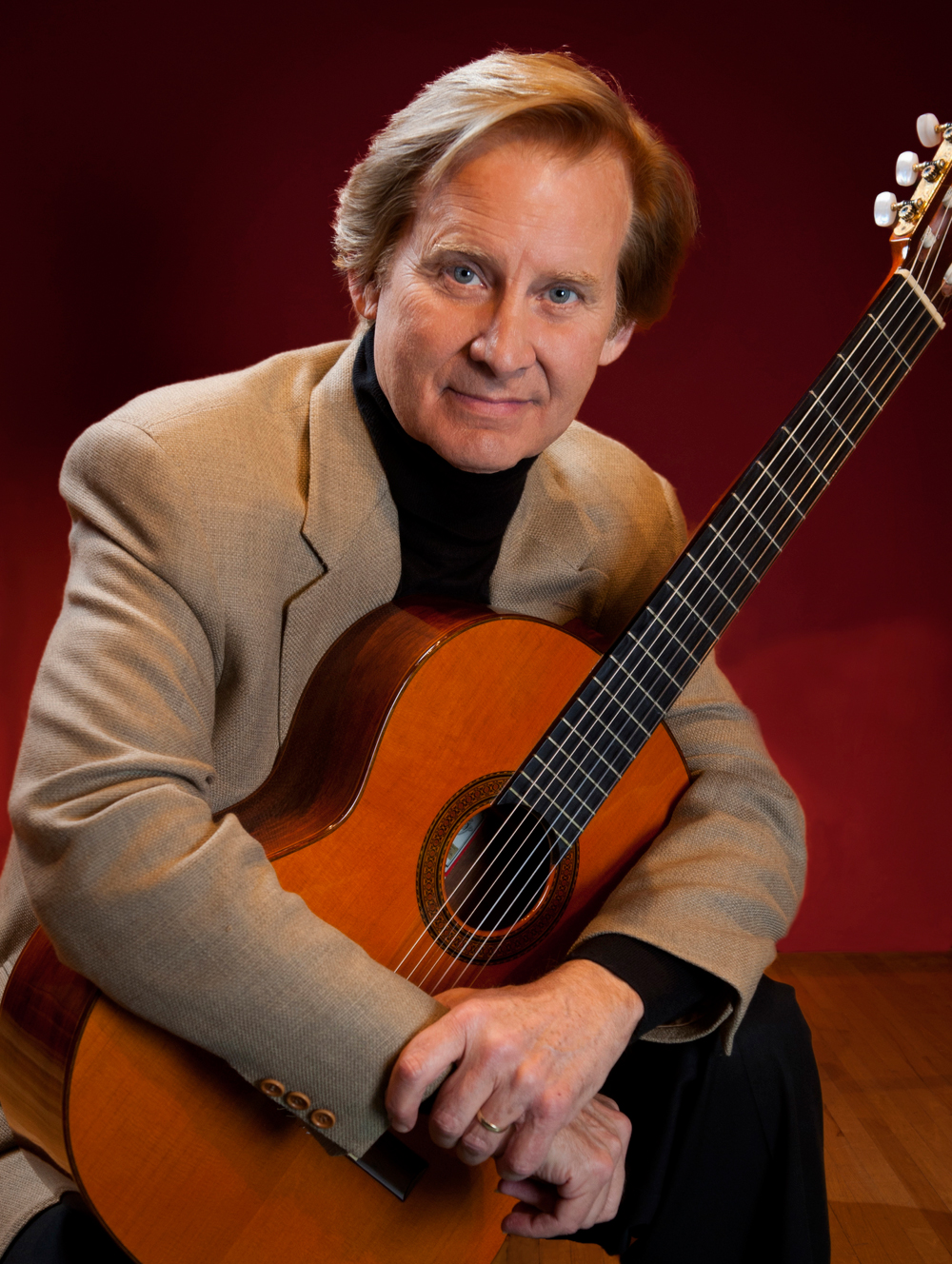 Christopher Parkening - America's 'Prince of the Classical Guitar'
Picture courtesy of: https://arts.pepperdine.edu/events/parkening/about-christopher-parkening.htm
Christopher Parkening is arguably the best classical guitarist to come out of America in all guitar history.
Being a student of both Celedonio and Pepe Romero went a long way to developing the young guitarist's innate talents and guitar technique.
Indeed, Parkening's virtuosic display in the 'Young Musicians Foundation' competition saw him compete as an "out of competition player" as there were no classical guitar categories and the judges.
By the way, the included Jascha Heifitz, Gregor Piatigorsky and Castelnuovo-Tedesco, who were too impressed with his playing to leave him out!
Over the years, Parkening has worked with, and been lauded by, many famous musicians including Castelnuovo-Tedesco, Segovia, Placido Domingo, Kathleen Battle and many others. He even appeared on 'The Tonight Show', and made numerous recordings for film scores etc.
Parkening has also won many awards over the years and even Grammy nominations, no mean feat in today's crowded musical landscape.
Segovia once said of him...
"Parkening is a great artist - he is one of the most brilliant guitarists in the world."
One of my favorite stories about Parkening and Segovia is where, as a fifteen-year-old, he was performing a Bach piece before Segovia in a master class...
Parkening's teacher at the time had used different fingerings to the Segovia edition which enraged Segovia to the point where he exploded with the comment...
"Change the fingerings back for tomorrow!"
With an ego like that who needs friends?
That story aside, Parkening had great affection and respect for the 'old master' and I'm sure it was reciprocated whilst the great man was still alive.
Parkening gave up concertising, recording and even playing for about four years. In his early thirties, he pursued his "dream" of early retirement on his ranch in Montana.
With nothing to do, but go fly-fishing and enjoying the wilderness, he soon tired of this lifestyle. He was feeling rather "empty" when a neighbor invited him to a local chapter of the Christian church where he heard a sermon entitled...
"Examine Yourself Whether You Be in the Faith".
This "struck" him very deeply, and from that moment on he dedicated his life to the Christian faith. He resurrected his career (sorry for the pun, but I just couldn't resist :)) with greater purpose than before and, as they say in the classics, "never looked back"...
Had Parkening not had that epiphany, the classical guitar world would have been robbed of one of its most shinning talents in all of guitar history!
Check out this great little video on YouTube of Christopher Parkening playing Koyunbaba at 'Harvest Crusade'...
Guitar History - Jeffrey
McFadden
'Complete
Classical Guitar Player'
 Jeffrey McFadden - Complete Classical Guitar Player
Jeffrey McFadden is best known for his recordings of guitar music by composers of the romantic era such as Fernando Sor and Napoleon Coste.
When I heard him play on a disc recently, I was pleasantly surprised. I'd not heard much about him before but knew straight away what a quality player he was.
I'm not just talking about guitar technique I'm talking about being a consummate artist and musician. As you can imagine, there is an enormous difference!
According to the bio on his webpage...
"McFadden has been acknowledged as one of the finest guitarists of his generation...
He has given World Premieres of works by numerous composers and has been a featured performer at several international music festivals...
His playing has received enthusiastic critical acclaim; the "Daily Telegraph" of London (UK) exclaimed "McFadden's ability to make the guitar sing is second to none"
...and "Classic CD" has described his playing as "major artistry".
Indeed, he is a lecturer in guitar at the University of Toronto, say no more!
Although Segovia, Williams, Bream and Romero et al deserve their place in the 'musical firmament' of guitar history, we should also look to other exciting new talent to inspire and thrill us with magical playing of the highest order.
This, I believe McFadden delivers for us.
As Segovia set down the foundations for all future guitarists, there was always going to be succeeding generations that develop and expand on technique, sound quality and repertoire.
As mentioned above, McFadden was presented the opportunity to give...
"World Premieres of works by numerous composers."
You don't get that opportunity unless you're a world class player of exceptional ability!
Here is Jeffrey Mc Fadden, playing in Duo
Spiritoso, Falla's La vida breve...
Guitar History - John
Williams
'Master of The Classical Guitar'
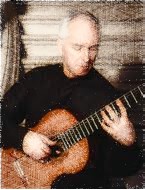 John Williams - Master of The Classical Guitar
John Williams is best known as a classical guitarist, but has explored many different musical traditions.
He is one of the finest classical guitarists of all time. Though he has delved into other areas of guitar and music that wouldn't be regarded as 'classical guitar', he nevertheless remains as one of its most proficient players in all guitar history.
Indeed, some people say, by varying the repertoire to include music from 'all walks of life' has probably ensured the instruments' survival as a viable long-term popular classical instrument.
Williams was born in Melbourne, Australia in 1941. His parents had migrated from England but ended up going back there some years later. This was in no small part due to the policies of the then conservative Menzies government who didn't fit with the Bohemian ideals of the Williams'.
Although Williams was taught guitar by Segovia, he was first taught by his own father Len, who was a pretty dab hand at the guitar, particularly jazz.
His tuition began at the age of seven. By the age of eleven, Williams had impressed Segovia who convinced his father to send him to the Academia Musicale Chigiana de Sienna in Italy.
It was here that Segovia ran his famous 'Summer Schools' and Williams won a scholarship there for the next five years. Indeed, at the request of his fellow students, he gave the first solo recital by a student of any instrument, so highly was his playing regarded.
Williams also studied piano and music theory at the Royal College of Music in London. According to Maurice Summerfield he gave his debut performance in the Wigmore Hall in London in 1958...
Williams continues to tour successfully around the world to this day. He has played in all types of ensembles as well as solo situations and can be regarded as one of the guitar greats of any epoch and any style guitar history.
Check out this great little video on Google of
Williams playing the 'Chaconne' of J.S. Bach...
Guitar History - Julian
Bream
'The
Ultimate Classical Guitar Player'
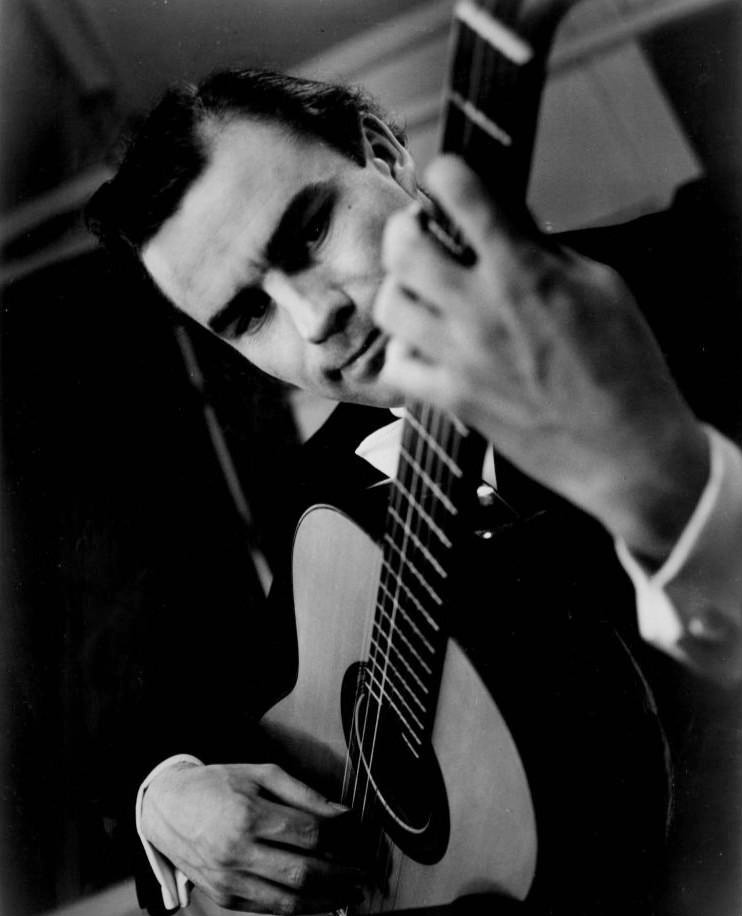 Julian Bream - The Ultimate Classical Guitar Player
Picture Courtesy of:By S. Hurok, https://commons.wikimedia.org/w/index.php?curid=19412131
Julian Bream was much influenced by the styles of Andres Segovia and Francisco Tarrega and is one of the best guitarists in all guitar history.
Although he made his professional debut over a 70 years ago (1947 in Cheltenham, England), he remains one of the pre-eminent classical guitarists of modern times.
Attracted to the playing of Django Reinhardt when only a small boy, Julian's destiny was sealed when he received a classical guitar on his eleventh birthday.
Although he was also studying piano at the time, (he won an award for his piano playing in 1945) guitar remained his first love. Indeed, by the time he was thirteen his reputation was growing way beyond the shores of his native England.
So impressed was Andres Segovia when he heard the thirteen-year-old he offered to teach the boy himself.
When Bream played a critically acclaimed concert at the Wigmore Hall in London in 1951, his fame and reputation were sealed. Throughout the 1950's, he started touring the world to rapt audiences.
This was on top of his master classes and an international summer school he headed in Wiltshire, England.
Bream received a Commander of the Order of the British Empire (C.B.E.) from the Queen in 1985.
Bream has recorded all the major works for guitar and even plays lute professionally, as well. He has won many international classical guitar awards for his superb playing including Grammy and National Academy awards.
In 1976, he won the Villa-Lobos Gold Medal, which was presented, to him by Madame Villa-Lobos herself.
In addition to all his wonderful abilities, Bream is an excellent transcriber of music for classical guitar. For instance, he transcribed Mozart's Five Divertimento's for Two Clarinets and Bassoon K. Anh. 229, among many, many others.
With the concerts, recordings and transcriptions he has made over the last half a century, Bream's position as one of the greatest classical guitarists of all time in guitar history is assured.
Check out this great little video on YouTube of Bream playing Grand Solo...
Guitar History - Narciso Yepes
'10-String Classical Guitar King'
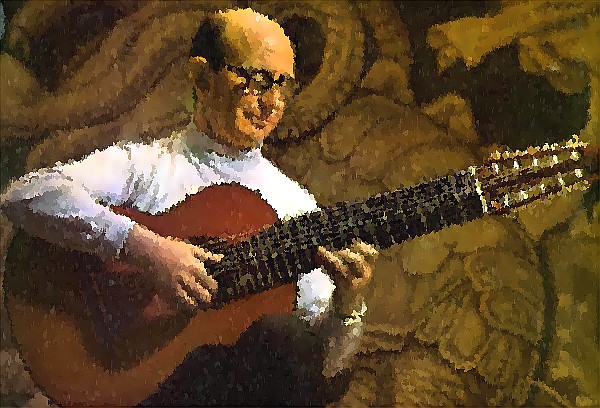 Narciso Yepes - '10-String Classical Guitar King'
Narciso Yepes was the first person to record the complete lute works of Bach on period instruments.
The young Yepes was only twelve years old when he started studying at the Conservatory of Music in Valencia. By 1943, he was good enough to make his debut at the Teatro Serrano in Valencia.
His great breakthrough came when in 1947, he performed Rodrigo's Concierto De Aranjuez to rapturous critical acclaim.
Although born into a poor family, Mr Yepes was to become a world-famous classical guitarist of the first rank. Some say he rivalled Andres Segovia for warmth and purity of tone! A compliment not to be scoffed at after all!
Indeed, he was a contemporary of the great master Segovia being born in 1927 and dying in 1997.
He began tuition at the early age of four after his father caught him pretending to play a guitar with an old, walking stick. It wasn't long before he started to play tunes by ear.
His father, realizing his son's obvious ability, took him to lessons although it must have been quite a strain on the family budget at that time.
Yepes performed internationally in most of the major musical centres throughout his long and distinguished career including France, Japan, Switzerland, the United States and Russia.
A tireless perfectionist, he designed a ten-stringed classical guitar, which expanded yet balanced the sound when compared to a normal six-string guitar.
Not content with this achievement he also works on updating and correcting old unpublished editions of baroque and renaissance music for guitar that number over 6000!
By the time he died in 1997, Yepes had achieved greatness in the eyes of not only his own native Spaniards, but also the entire music-loving world.
His hometown of Lorca has perpetuated his memory with a sculpture of the guitarist in the Simon Mellado Square. A fine classical guitarist, one who left a recorded legacy for guitar history and us all to benefit.
Check out this great video on YouTube of Yepes
playing Bach...
Guitar History - Pepe
Romero
'Classical Guitar Sophistication Personified'
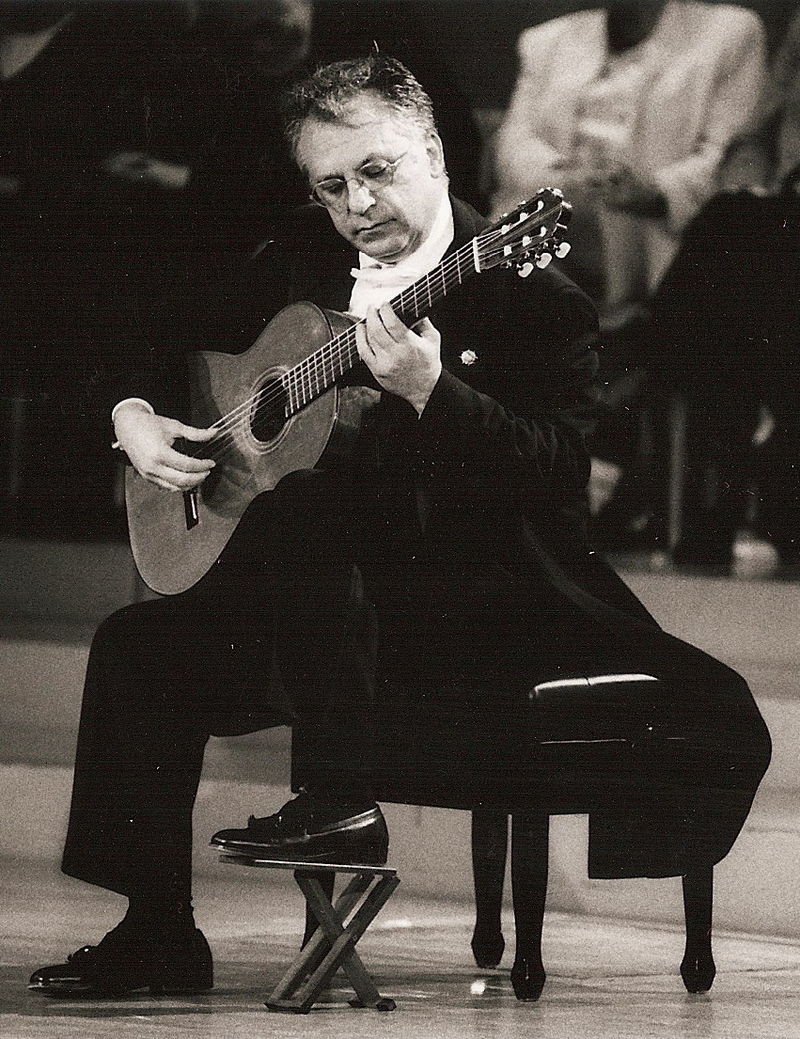 Pepe Romero - Classical Guitar Sophistication Personified
Picture Courtesy of Hans Bernhard https://commons.wikimedia.org/w/index.php?curid=6094301
Pepe Romero is celebrated worldwide for his thrilling interpretations and flawless technique.
He is one of the most remarkable and proficient players in the modern era of classical guitar. Often astounding audiences with his dazzling guitar technique, Romero has obtained a mastery that is very rare indeed.
Born in Malaga, Spain in 1944, he started playing the guitar at age three with his father Celdonio. Although he only ever studied guitar with his father, he did study music theory in both Spain and America.
By the time he was fifteen Romero had moved to America with his family, he was good enough to make his first recording. Throughout his career, he has played as both a soloist and in ensembles, especially with his family.
Romero is not only talented on classical guitar but is also a very fine flamenco guitarist. He has played in concerts the world over to great critical acclaim.
(The flamenco guitar is constructed using different woods, has a thinner soundboard and a shallower body than the classical guitar. This is to help its peculiar tonal qualities of warm tone and greater 'attack' than the classical guitar but leads to a shorter sustain of notes.)
Romero also gives of his talent by teaching the guitar at the University of Southern California. He has added to guitar pedagogy with a method book.
Romero and his brother Angel played the first performance of Rodrigo's Concerto Madrigal for two guitars and orchestra way back in 1970.
Like many other great players, Romero has inspired guitar composers to write for him. They have been composers of the very highest quality, Rodrigo and Albeniz to name but two.
His opinions and knowledge of the guitar are much sought after.
Romero is also a leading personality in the film documentary 'Shadows and Light: Rodrigo At 90', which has received numerous awards, including those from the Chicago International Film Festival, the International Emmy Awards and the San Francisco International Film Festival.
Having made over fifty recordings to date Pepe Romero continues to create music of an unbelievably high standard.
So cherished is he in his homeland of Spain that, along with his brothers, he was made a knight by King Juan Carlos I of Spain, in the Order of "Isabel la Catolica" in 2000.
When all is said and done, the contribution to the classical guitar in the modern era of Romero is up with the best of them.
A true classical guitar giant in terms of guitar history!
Check out this great little video (It's a little raw!) of Mr Romero on Google video playing 'Layenda'...
Guitar History - Andres
Segovia
'Missionary
of The Classical Guitar'
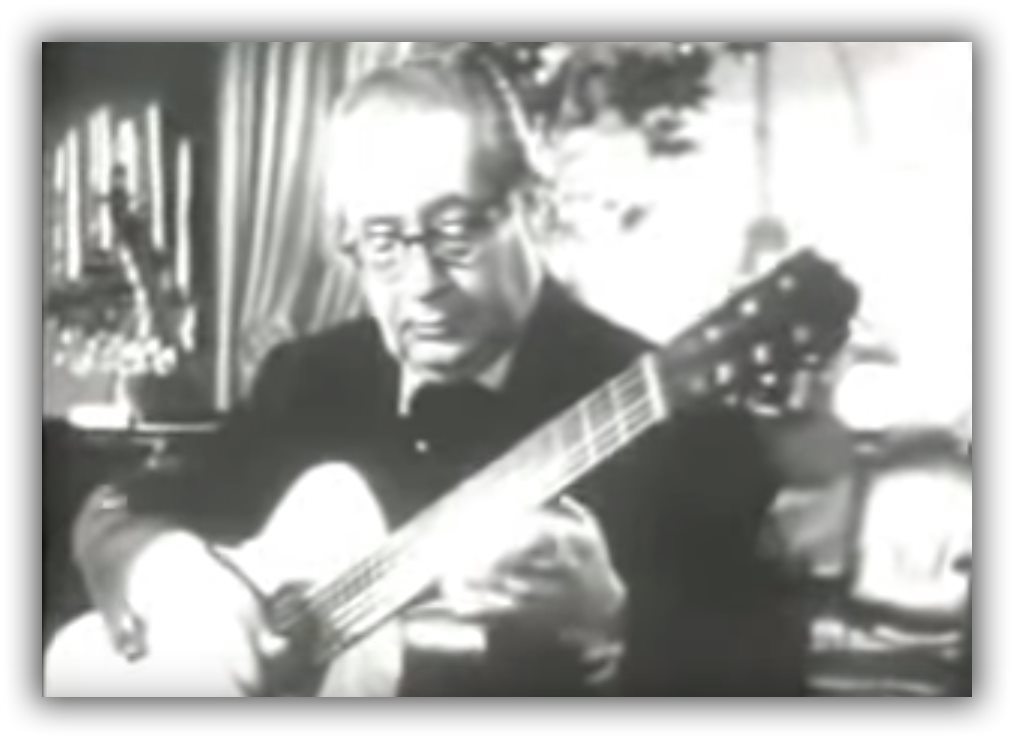 Andres Segovia - Missionary of The Classical Guitar
It is a generally accepted notion that Andres Segovia was the most popular and important figure in the whole of classical guitar history.
What would have been the fate of classical guitar if not for an ignorant, mean old violin teacher?
When his violin teacher pinched the young violinist every time he played a wrong note and demonstrated a 'very poor tone', he had no idea he was helping to shape the future of classical guitar forever!
Yes, perhaps Andres Segovia, with his fanatical love of the guitar, was 'chosen' for the instrument. It is interesting to note the strange twists and turns of fate that is a part of all great historical events. His violin teacher may well have been supportive and brilliant...lucky for us wasn't!
As Maurice J. Summerfield stated in his wonderful book...The Classical Guitar, Its Evolution, Players and Personalities Since 1800)...
"There is not one classical guitarist alive today that has not been influenced by Andres Segovia"
He was born in 1893 in Linares, near Andalusia in Spain. Turning away from the violin and disregarding all advice to the contrary, he found himself, at a very young age, attracted very strongly to the guitar.
Genius, like water, always finds its own level. The young man, after very little tuition, began a lifelong quest to take the classical guitar to undreamed of new heights.
He became... "his own master and his own pupil" and continued throughout his very long life to champion the cause of classical guitar in all areas of musical life.
The plaudits came for Segovia after the first concerts he played at the age of sixteen (although his official debut was in Paris in 1924). From that moment on he played to rapt audiences worldwide for the rest of his life.
Indeed, even in old age Andres managed a hectic schedule of over sixty concerts per year well into his nineties all over the world!
Throughout his life Andres' achievements were many and great. For instance, he was one of the very few classical guitarists who earned a gold record for having sold over a million copies of a single record!
He persuaded many contemporary composers who would not have ordinarily written for the guitar to compose some very fine music indeed. Manuel Ponce, Heitor Villa-Lobos, Albert Rousell and Manuel de Falla to name but a few.
Andres must have been a very persuasive character, and it has been said that he often would wax long of the guitar's capacity for harmony and counterpoint.
He was even instrumental in persuading (along with Augustine) the manufacturers of guitar strings to change from catgut to nylon strings.
Also, he had a life-long goal of widening the repertoire. He wanted to convince the 'powers that be' in the conservatories to include guitar instruction in their courses.
He wanted to "lift" the guitar from its generally, folkloric past. Indeed, in true missionary style he took the guitar from... "the gypsy haunts and almost alone elevated it to its honoured place on the concert stage."
Guitar History Sidebar - Did You Know?
Segovia used to get so nervous before a concert that he would submerge his hands in a warm water bowl to get the blood flowing just to enable him to play!
With the sort of flack, he was receiving from the 'more established' classical artiste's (they laughed at him openly) it couldn't have been easy for Andres Segovia.
He was not to be thwarted!
His passion and zeal were real. He wasn't going away! Just what was his legacy?
Andre Tubeuf has said that his achievement was to...
"Create a discipline, a school, a repertoire. He has lived to see the guitar become a great instrument that is popular and classical at the same time."
I believe that is true but only part of the classical guitar story within guitar history.
If it hadn't been for this man's single-minded belief in himself and total love for our beautiful instrument it would have been "consigned to the tenements of musical history, only a bit player in a glorious musical firmament."
Most classical guitarists are in awe of what Segovia has achieved for guitar. Not only did he refine most of the developments made by Tarrega in the previous century, he gave it a warmth and charm that no other instrument before it or since, has ever managed to capture.
Indeed, he played with a more relaxed right hand than Tarrega and used the left-hand side of his nails and the skin of his fingertips to achieve a great warmth and beauty of tone.
This technique was passed on to generations of classical guitarist's both through his world-famous master classes and through the many teachers of classical guitar that were influenced by his technique and quality of performance.
Whenever and wherever there is a discussion about the development and history of classical guitar you can be sure that the name Andres Segovia shall be one of the main topics of that discussion.
There was no one before or since who played such a crucial role in the classical guitar's place, in guitar history!
Check out this great little video on YouTube.com of "the master" playing Sor's "Magic Flute" variations...
Guitar History - Sharon
Isbin
'Classical
Guitar Artistry Unrivalled!'
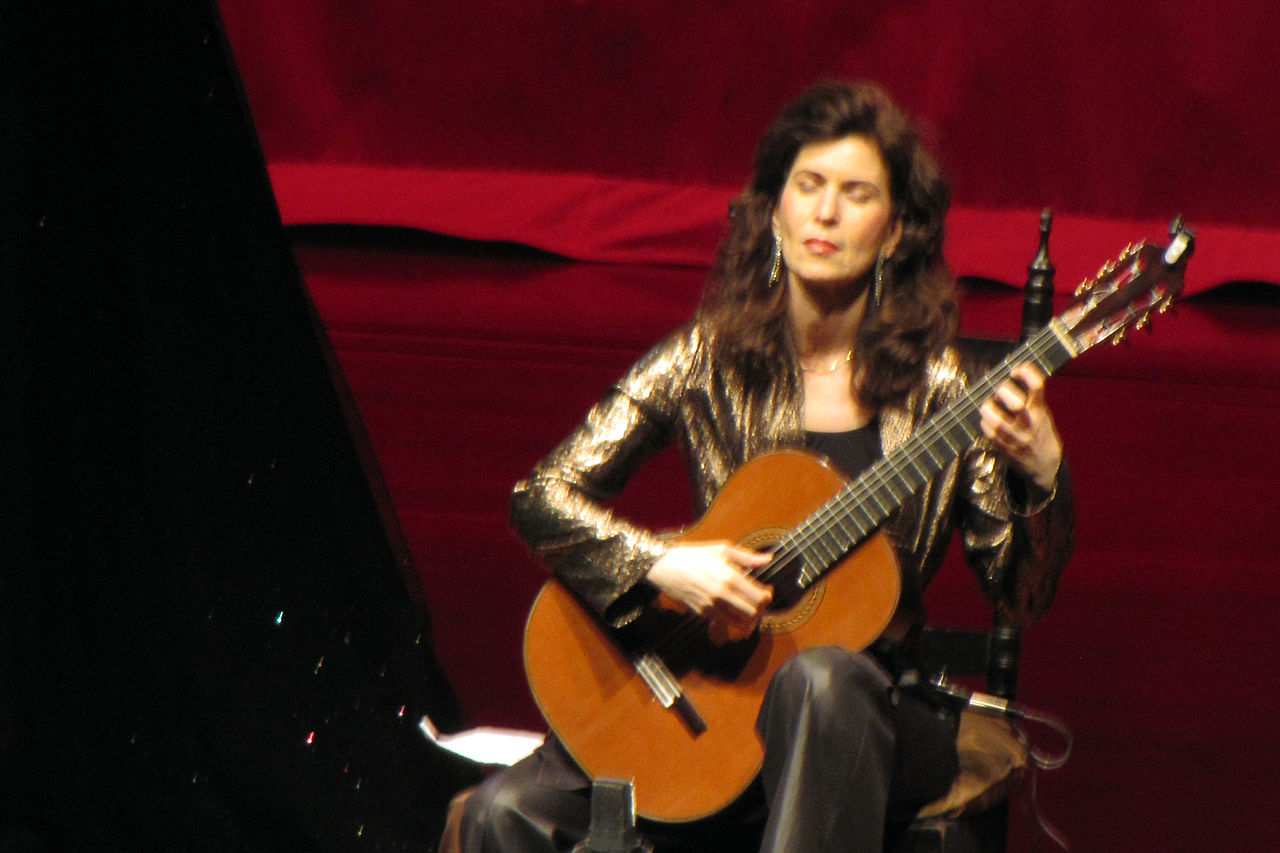 Sharon Isbin - Classical Guitar Artistry Unrivalled!
Picture Courtesy of: By laembajada - https://commons.wikimedia.org/w/index.php?curid=28868318
Sharon Isbin is acclaimed for her extraordinary lyricism, technique, and versatility.
Ms Isbin was only nine years old when she first studied guitar. That was in Italy after her father had taken the family from their native America, so he could complete a year's sabbatical from the University of Minnesota.
Her innate artistry was almost immediately apparent.
When Isbin returned to America, she continued to study with such guitar luminaries as Oscar Ghiglia and Alirio Diaz in master classes. She also went to Sophocles Papas to enhance further her wonderful guitar technique.
Not only has Isbin achieved a level of artistry unrivalled by most in her playing but backs this up with solid academic qualifications.
Indeed, she obtained her master's degree in music from Yale University.
Isbin has won many top prizes in guitar competitions for her eloquent artistry including:
* Canadian International Guitar Competition,
* Munich International Guitar competition,
* Queen Sofia International competition in Madrid, Spain.
Guitar History Sidebar - Did You Know?
Sharon Isbin became the first guitar professor at the highly respected Julliard School of Music in America.
After a highly successful debut in 1977 at the Wigmore Hall, in London, the critics "raved", and Isbin's reputation as one of the world's foremost guitarists in guitar history was assured.
She went on to debut in her native America in 1979 at the Alice Tully Hall, Lincoln Centre in New York, again to rave reviews. Sharon has continued to perform around the world since that time whilst maintaining a hectic academic schedule of teaching and giving master classes.
In a classical guitar world mostly dominated by men Isbin is a shining example of how nature bestows its grace.
In other words, she'd outplay most men with her left hand tied behind her back!
So beautiful is her tone and artistry, and so great is her dedication that she could never be overlooked when the discussions of guitar history turn to the greatest guitarists of all time.
Check out this great little video on YouTube of
Ms Isbin playing Tarrega's Recuerdos del Alhambra...
Famous Classical Guitar Makers
Who Was the Best Classical Guitar Maker?
"Guitar Maker or Luthier - A maker of stringed instruments..."
When you try to weigh up who the most important classical guitar luthier of all guitar history was, you quickly realize it is a really difficult question to answer.
After the eighteenth century, where the five-course guitar was largely in vogue, there came several guitar makers who improved the design and thus the performance of the classical guitar.
The person who probably made the most difference and who still has an impact on the modern classical guitar was Antonio Torres.
Born in Spain in 1817, Torres was able to strengthen the guitar by fan-strutting drastically. This is a method of outwardly radiating patterns of wood on the underside of the guitar soundboard
Torres also enlarged the body of the guitar compared to the nineteenth century instrument thus giving it more volume. Being both a player and an excellent craftsman, Torres realized, more than most that precision and refinement were all important for improving the instrument.
Indeed, the specifications to which he built his guitars became almost the standard for classical guitar construction and his influence can be felt right up to the present day and a 'reverberation throughout guitar history.
He worked with great guitarists of the day, to fine-tune his specifications, even the famed Francisco Tarrega. Although he had to work in closely with these people, Torres was quite paranoid about people discovering his methods of guitar construction.
It is said he used to lock up his workshop from even his closest relatives whilst constructing his guitars.
Other refinements Torres made to the guitars he constructed, in relation to standard guitars of the day, were broadening the fingerboard, and lengthening the strings.
Torres was often more concerned with performance over looks, paying less attention to detail, in terms of ornamentation of the instrument. Torres always, it seemed, went for results.
Torres made instruments of greater power in volume and tonal production and led the way for future luthiers to build on his outstanding specifications.
Guitar History Sidebar - Did You Know?
Antonio de Torres was apprenticed as a carpenter at the age of 12. When he died in 1892, he was virtually broke!
Another luthier that could be regarded as one of the best of all time in guitar history is Jose Ramirez along with his younger brother Manuel. They were born in Madrid in Spain and established a long family line of quality luthiers.
A "Ramirez" is still a status symbol and one of the most popular guitars among classical players today.
Although they argued and eventually split from each other, the Ramirez brother’s created guitars of great quality though differing in design from each other.
Jose became popular with Flamenco players as the tone production, and lighter construction suited their purposes. This is not to say his classical instruments were inferior; indeed, the opposite is true.
Manuel Ramirez followed in the traditions established by Torres. His guitars had a rich full-toned, bell-like quality about them yet were still capable of subtle mood shifts and nuances.
Manuel Ramirez once gave one of his guitars to Andres Segovia who played it in many concerts all over the world.
Fact: The earliest proponent of fan strutting in guitar history was Francisco Sanguino of Seville in 1759 fifty-eight years before Antonio de Torres was born.
The Ramirez brothers inspired many other guitar makers who followed in their footsteps including Hernandez, Estio, Barbero and Fernandez.
Another guitar maker of note was Ignacio Fleta. Another Spaniard, he lived from 1897 to 1977.
He was very highly regarded, and his guitars are much sought after today. He was taught the basics by his father but received further instruction in Barcelona when he was still in his teens.
Fleta also made other instruments such as cello's and violins but turned exclusively to guitar after hearing the great Andres Segovia play.
Indeed, so impressed was he with Segovia that he built him several guitars, which Segovia used in concerts over many years. What a boon to guitar history!
In recent years, the Australian guitar maker Greg Smallman has become popular due to his excellent craftsmanship and exacting methods of construction.
Obviously influenced by the designs of Fleta, Smallman has made guitars for many fine classical guitarists including John Williams, Stephan Rak and the emerging Timothy Kain.
Indeed, with the endorsement of Williams in the early 1980's Greg Smallman's career was secured as Williams was (and is still) one of the most high-profile classical guitarists of all time. Williams must have been impressed with Smallman's instruments as he still uses them to the present day.
Not a guitar maker to rest on his laurels, Smallman continually experiments with guitar design. He came up with an innovation in the early 1980's called the "lattice bracing system".
His guitars today also have 'armrests' on the upper bout of the guitar so that the guitarist's arm is not resting on the instrument, therefore, gives more volume when played. He has even designed a guitar with an adjustable neck.
This allows the player to adjust the action without releasing the strings or even altering the saddle.
The flamenco guitar is constructed using different woods, has a thinner soundboard and a shallower body than the classical guitar. This is to help its peculiar tonal qualities of warm tone and greater 'attack' than the classical guitar but leads to a shorter sustain of notes.
The future of classical guitar is secure due to the craftsmanship, hard work and love of the above-mentioned guitar makers (as well as other minor guitar makers).
From time to time throughout guitar history there are innovations, but from the time of Antonio Torres the basic design of guitar has been established.
There is no valid reason to depart from these basic principles as they work so well. In other words... "If it ain't broke, don't fix it!"
To read more about Torres and classical guitar making go here...
Guitar History - Paulino
Bernabe
'Classical Guitar Maker Extraordinaire'
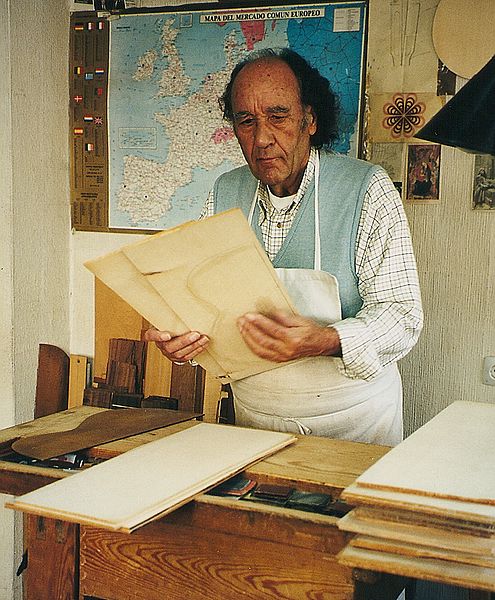 Paulino Bernabe - Classical Guitar Maker Extraordinaire
The year was 1932. John Phillip Sousa, composer of Semper Fidelis and Stars and Stripes Forever died.
Amelia Earhart was to fly solo across the Atlantic Ocean - the first woman to do so.
Hitler and some of his cronies were skulking around Germany laying the seeds of possibly the most disgusting episodes in world history.
The Sydney Harbour Bridge was opened in Australia by the then premier of New South Wales Jack Lang.
There was a famine in Russia, and the U.S. celebrated the 200th anniversary of Washington's birth.
In that very same year in Madrid, Spain, Paulino Bernabe was born!
He is not only one of the finest classical guitar makers we have seen but is now inextricably linked to classical guitar history.
To explain further, not only did he study with possibly the most famous modern-day classical guitar maker in Ramirez, but he actually studied classical guitar playing with Daniel Fortea, famous student of Tarrega.
Indeed, he was still in his formative years when he came under the instruction of Fortea and studied for at least four years with him.
This 'two-pronged' connection ensures he will always be coupled with the history of classical guitar and guitar history in general.
His trade was that of cabinet maker, like so many great classical guitar makers were or are. In fact, it was at the rather late age of 22 that he was apprenticed into the guitar making trade with no less than the famed Ramirez workshop.
By the time Segovia took a 'fancy' to the Ramirez instrument, he had become a leading guitar maker in that firm.
He kept working away and honed his skills for 15 years until he felt he had the knowledge and where withal to go it alone.
Go it alone he did!
Viewing it through the context of history (not just guitar history), the world was changing dramatically.
Dylan, the hippies movement, the death of Martin Luther King, civil unrest and the U.S. mired in Vietnam. It was then that he started his own old-world workshop in 1969.
A stark contrast to the ever-shifting new age, he continued with traditions that were age-old.
There must have been something so satisfying for Paulino personally to work away in his workshop, the smell of the wood, the slow but constant shaping of the various pieces, the contentment of the finished instrument...
"And He looked at all that he had created and saw that it was good!"
Well, perhaps it's a stretch to compare him with Him :))
His work is ‘good’ to this day.
I must say I'm a little biased as I've recently purchased a ‘Paulino Bernabe 20’ and I love it! Not that Bernabe himself was full of ego. Rather, he stated of his guitars...
"Some guitar makers feel that they have made instruments superior to all others, but I do not think I have yet produced the best guitar ever made. So far, there is no equivalent to a Stradivarius among guitar makers, but one day I hope to produce the exceptional guitar."
Continuing to experiment with different strutting and new ways of construction, he seemed to settle on some very effective and long-lasting designs.
Indeed, his guitars have been used by many famous classical guitar players over the years including the 10 string he made for Narciso Yepes and recently, the one and only John Williams had bought one.
His son, Paulino junior is carrying on the guitar history tradition of great guitars since his death in May of 2007.
Here's some guitar models from Paulino Bernabe at Guitarras de Luthier, Madrid
Here's a little YouTube Video of some Paulino Bernabe guitars..
Guitar History - Hermann
Hauser
'German Precision...Spanish Passion!'
 Hermann Hauser - German Precision...Spanish Passion!
The talented classical guitar maker Hermann Hauser was born in 1882 and died in 1952.
Both his son and grandson followed him into the profession as he had followed his own father into an instrument-making tradition. Indeed, he is remembered as a guitar maker of true class and quality.
He eventually started building guitars in the Spanish tradition based on the work of Torres.
Having instrument making ‘in his blood’ after studying with his father and at the State School for Violin Making, he ‘married’ this with a ‘steely German engineering outlook’. It was no wonder he produced guitars of such quality and timbre.
His guitars were so good that even the redoubtable Segovia was impressed by the quality of his work.
Segovia eventually encouraged him to copy his 1912 Manuel Ramirez guitar, an instrument generally believed to have been built by Santos Hernandez.
Segovia made many famous recordings with that wonderful classical guitar over the years which helped to seal his reputation as one of the pre-eminent guitar makers of the day in overall guitar history.
Hermann's son made a guitar for Segovia just before the great man died in 1987.
Segovia had met him on his first concert tour through Germany in 1924. After inspecting some of his guitars he stated that "...I immediately foresaw the potential of this superb artisan..."
Some of the famous names, other than Segovia, to use a guitar made by Hermann were: Julian Bream, the famous English classical guitarist.
Bream has been on the classical guitar scene since he made his debut in 1947 at the age of 14. Bream convinced luthier Jose Romanillos to make copies of Hermann’s guitars, which was a nod to this great guitar maker.
Both Pepe and Angel Romero, famous the world over as part of “Los Romeros” guitar group also used copies of the great man’s guitars.
In fact, there are quite a few luthiers throughout the world who have based the style of their guitars on his original. It is their quality, attention to detail, and satisfying results that draw everyone to his designs.
I’m sure his guitars will be copied for generations to come!
It can be safely said that Hermann Hauser is generally regarded as the best classical guitar makers outside of Spain in the guitars' long and rich guitar history.
Listen to the responsiveness of these beautiful guitars played by Segovia...
Here's more information on the guitar...
Recent New Pages:
What is Classical Guitar Playing?
Arpeggio Beginner Guitar Lesson Classical-Fingerstyle Portal
Blog Technique Free Guitar Lesson
Guitar History Guitar Instruction Guitar Lessons
Guitar Time Line Malaguena Memorizing Music
Music Notation Music Notation Primer Sight Reading
Sight Reading Guide Theory Work Sheets Renaissance Guitar